What Is a Nursing Compact State? Full List & Guide for Travel Nurses
For a travel nurse, one piece of paper can be the difference between starting a contract next week or waiting three months. That paper is a multistate license, and whether you can use it comes down to a single question: is the state a nursing compact state?

We Care Staffing
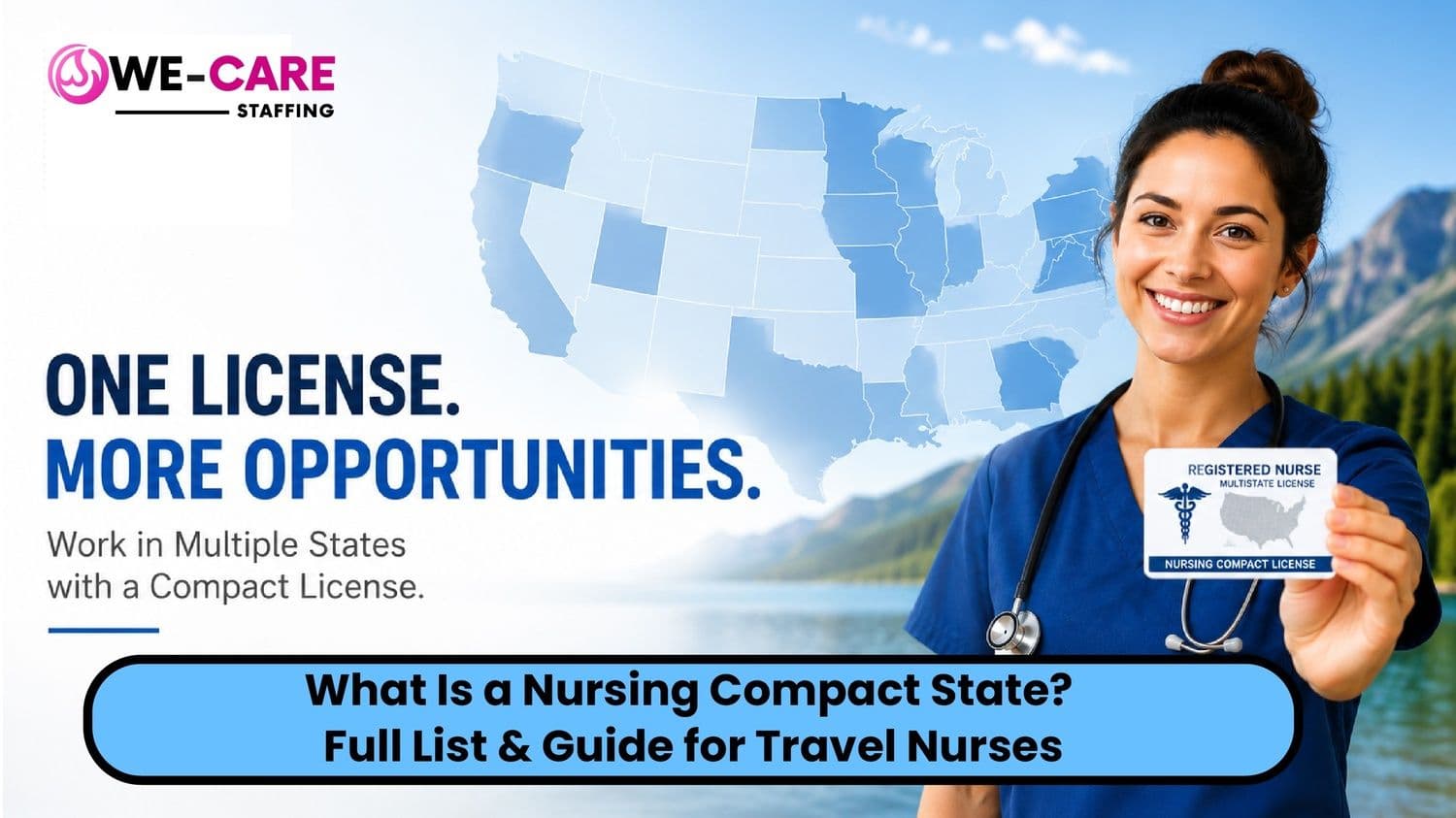
This guide explains what a nursing compact state is, how the multistate license works, who qualifies, and which states are in (and out) as of 2026. Because the list genuinely changes as states pass and implement legislation, we'll also show you how to confirm the current status yourself, so you never plan a contract around outdated information. If you're ready to look at assignments, you can explore current travel nursing opportunities with We Care Staffing as you read.
What Is a Nursing Compact State?
A nursing compact state is a state that participates in the Nurse Licensure Compact (NLC), an agreement among member states that lets a registered nurse (RN) or licensed practical/vocational nurse (LPN/LVN) hold one multistate license and practice in every other compact state, without applying for a separate license in each one.
The compact is administered by the National Council of State Boards of Nursing (NCSBN), which maintains the official list of member states. The current version, the Enhanced Nurse Licensure Compact (eNLC), took effect in 2018 and replaced the original 2000 compact, adding a set of uniform licensure requirements that every multistate license holder must meet.
The core idea is simple: instead of a patchwork of individual state licenses, a qualifying nurse gets one license from their home state that travels with them across all member states.
How a Multistate License Works
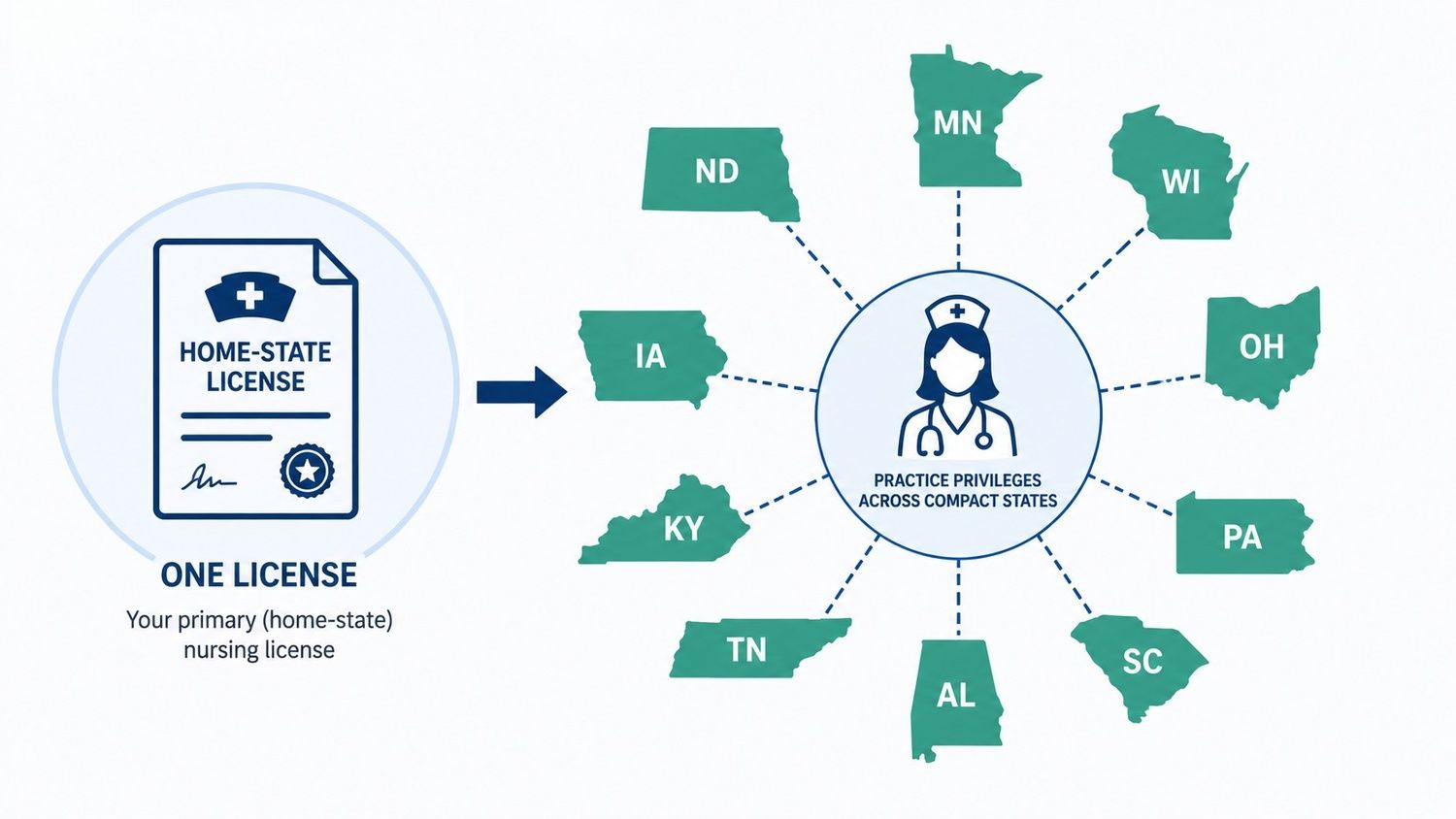
Here's the mechanic that matters most. A multistate license is issued by your primary state of residence, and it only works if that home state is a compact member. Once you hold it, you can practice in any other compact state under "compact privilege," without new applications, fees, or waiting periods.
A few rules that trip nurses up:
- Your home state must be a compact state. You can't simply choose a compact state for its license; your primary state of residence (where you vote, pay taxes, and hold your driver's license) must be an NLC member.
- The license follows the patient's location. When you practice across state lines, including telehealth, you must follow the nursing laws and scope of practice of the state where the patient is located.
- Moving resets things. When you change your primary residence to another compact state, you must apply for a new multistate license in your new home state, generally within a set window (commonly cited as 30 to 60 days depending on the state). Miss it, and your old license can convert to single-state only.
- A compact license does not override non-compact states. If you want to work in a non-compact state, you still need that state's own license, no matter how many compact states your license covers.
The Full List of Nursing Compact States (2026)
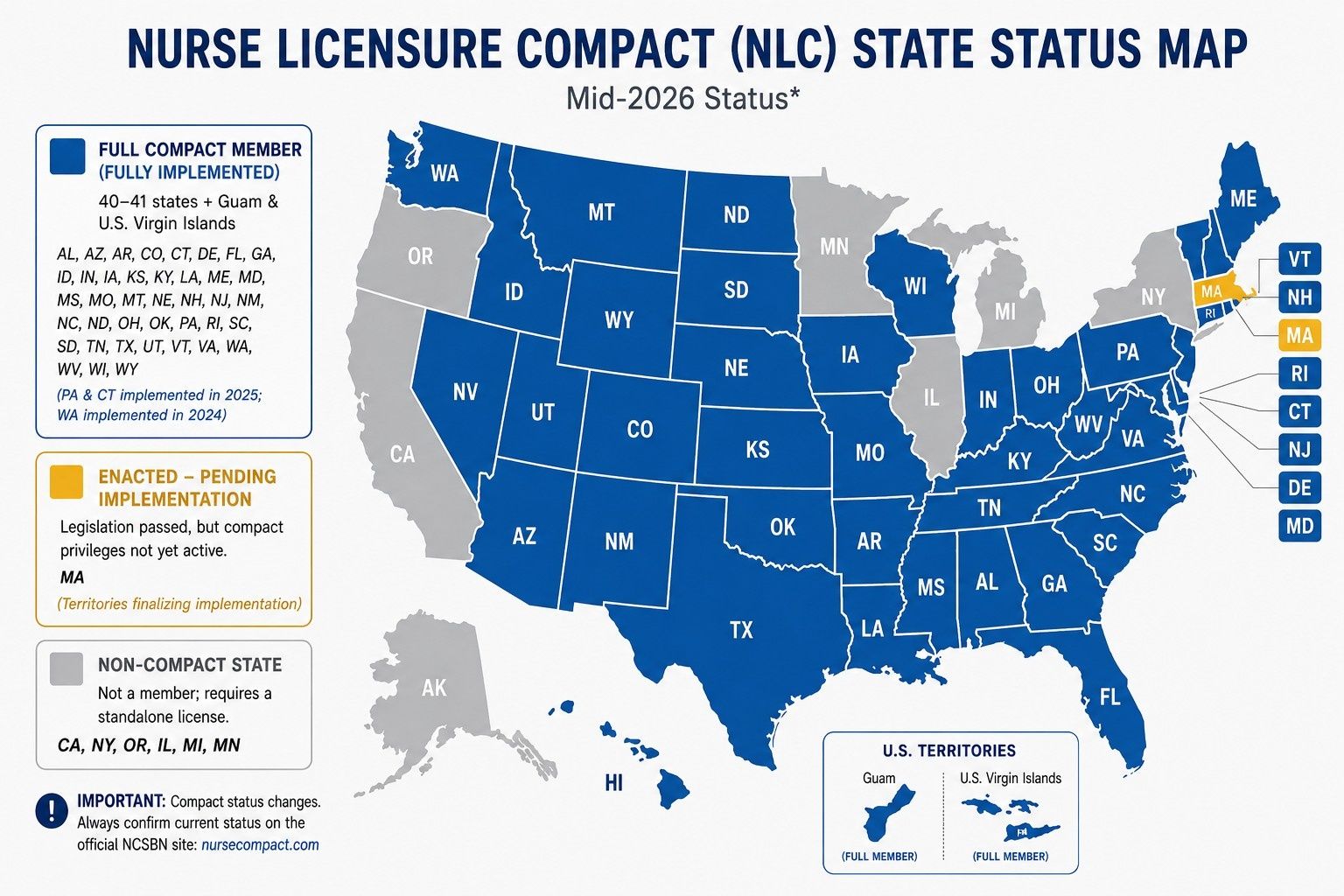
Important: The compact list changes as states enact and implement legislation, and different sources count "enacted" versus "fully implemented" differently. The figures below reflect the landscape as of mid-2026. Always confirm current status on the official NCSBN compact site (nursecompact.com) before accepting an assignment.
As of mid-2026, roughly 40 to 41 U.S. states are fully implemented NLC members, plus the U.S. territories of Guam and the U.S. Virgin Islands, for a total in the low-to-mid 40s in jurisdictions. Fully participating states include, among others:
Alabama, Arizona, Arkansas, Colorado, Connecticut, Delaware, Florida, Georgia, Idaho, Indiana, Iowa, Kansas, Kentucky, Louisiana, Maine, Maryland, Mississippi, Missouri, Montana, Nebraska, New Hampshire, New Jersey, New Mexico, North Carolina, North Dakota, Ohio, Oklahoma, Pennsylvania, Rhode Island, South Carolina, South Dakota, Tennessee, Texas, Utah, Vermont, Virginia, Washington, West Virginia, Wisconsin, and Wyoming.
Recently active states worth noting for travel nurses: Pennsylvania and Connecticut both reached full implementation in 2025, opening up the Northeast considerably, and Washington implemented in 2024.
States that have enacted but not fully implemented
A few jurisdictions have passed NLC legislation but have not yet turned on compact privileges. As of mid-2026, these commonly include Massachusetts (enacted, implementation pending) along with the territories still finalizing implementation. In these places, you generally still need a single-state license until the board announces a go-live date, so verify before you rely on compact privilege.
Notable non-compact states
Several large states remain outside the compact, which matters enormously for travel nurses because you'll need a standalone license for each:
- California (the largest nursing market in the country, repeatedly proposed but not passed)
- New York (enacted or pending discussions have occurred, but not implemented as a working compact for practice; verify current status)
- Oregon
- Illinois, Michigan, Minnesota (some with pending legislation)
Because a few of these have pending or evolving legislation, their status is exactly the kind of thing to double-check against NCSBN rather than assume.
Who Qualifies for a Multistate License?
To hold a multistate license under the eNLC, you must meet the compact's uniform licensure requirements, which every member state applies. These generally include:
- Primary residence in a compact state (the foundational requirement).
- An active, unencumbered RN or LPN/LVN license.
- Passing the NCLEX (or a predecessor exam).
- A valid U.S. Social Security number.
- State and federal criminal background checks, with no disqualifying convictions.
- No current discipline on your license and no participation in an alternative program restricting practice.
If your home state is compact and you meet these, you apply for the multistate designation through your home state's board of nursing.
Why the Compact Matters So Much for Travel Nurses
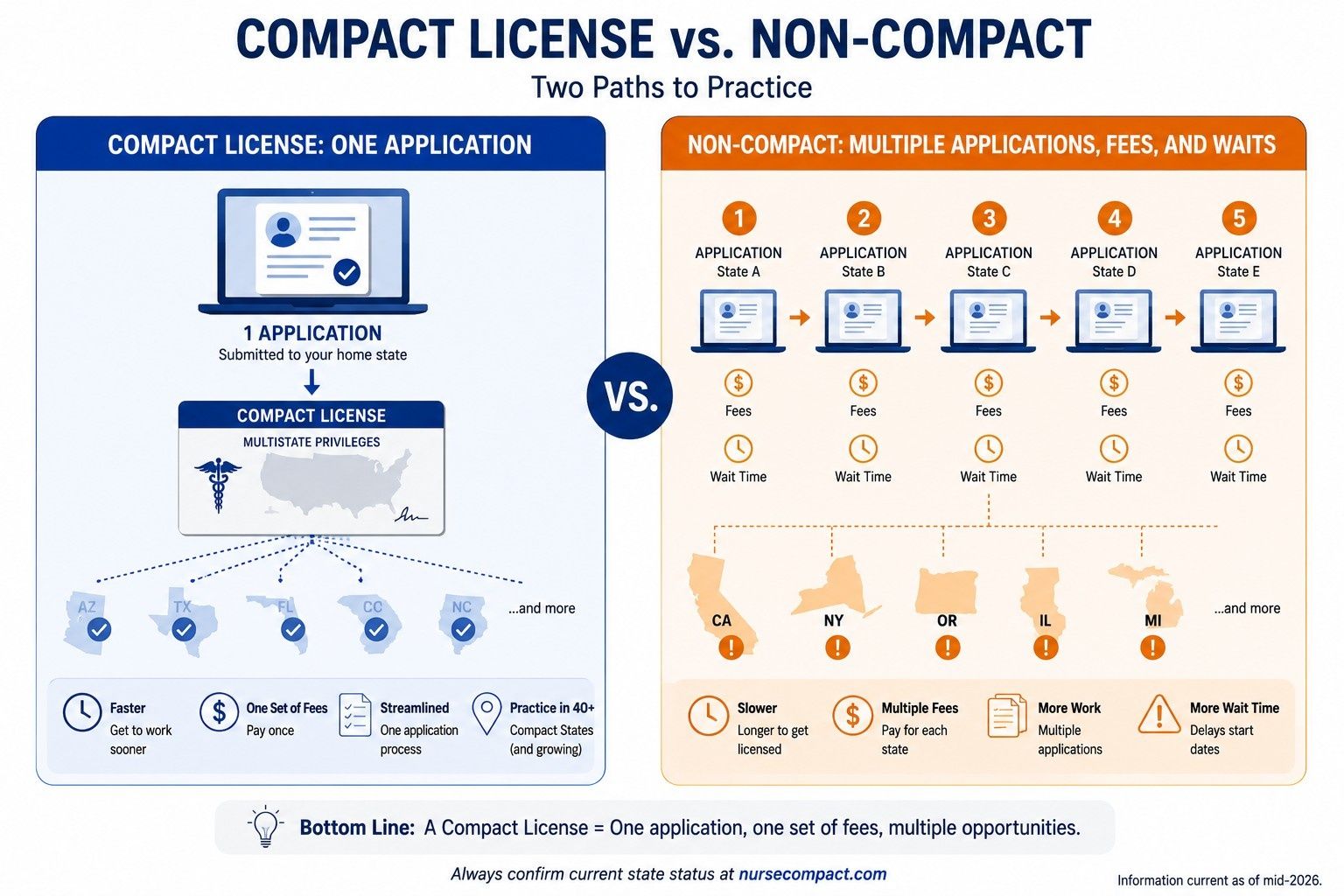
For travel nurses, the compact is arguably the single most important licensing factor in the job. Consider the difference:
- With a multistate license: You apply once, in your home state, and can accept contracts across all compact states with no additional waiting. That means starting assignments in days rather than weeks, chaining contracts back to back, and jumping on high-demand openings the moment they appear.
- Without it (non-compact states): Each state requires its own application, background check, fee, and processing time, often weeks to months. A California or New York assignment, for example, requires a standalone license obtained well in advance.
The practical strategy many travelers use: establish primary residency in a compact state, hold a multistate license for maximum flexibility, and budget extra lead time whenever a contract takes them into a non-compact state. If you'd like help matching your license situation to specific assignments, reach out to our team and a recruiter can map it out with you.
How to Verify a State's Current Compact Status
Because the list changes, treat any article, including this one, as a starting point rather than the final word. To confirm current status:
- Check the official NCSBN compact site (nursecompact.com), which maintains the authoritative, up-to-date member list.
- Confirm with the specific state board of nursing, especially for states that recently joined or are pending.
- Verify a specific license through Nursys (nursys.com), NCSBN's national verification database.
- Ask your recruiter or agency, who track these changes continuously because they affect every placement.
A two-minute check can save you from planning a contract around a privilege you don't actually have.
Conclusion
A nursing compact state is one that participates in the Nurse Licensure Compact, letting qualifying nurses practice across all member states on a single multistate license issued by their home state. For travel nurses, that one license is a career superpower: it removes the biggest source of delay between you and your next assignment. As of 2026, roughly 40-plus states participate, with more moving through legislation, while a handful of large markets like California, New York, and Oregon remain outside and require their own licenses. Understand how the compact works, confirm current status on the official NCSBN list before each assignment, and you'll always know exactly where your license can take you. When you're ready, explore current travel nursing assignments and let a recruiter help you plan around the compact map.
References & Sources
All data points are drawn from the following publicly available sources (accessed June 2026). NCSBN is the authoritative baseline; compact membership changes over time, so verify current status there.
- National Council of State Boards of Nursing (NCSBN) / Nurse Licensure Compact — official member list and rules: https://www.nursecompact.com
- NCSBN — Nurse Licensure Compact overview: https://www.ncsbn.org/nurse-licensure-compact.htm
- Nursys — national license verification database: https://www.nursys.com
- RegisteredNursing.org — 2026 NLC guide (member counts, pending states, implementation status): https://www.registerednursing.org/articles/nursing-license-compact/
- Nurse.org — Compact nursing states list 2026 (recent implementations, telehealth rules): https://nurse.org/articles/enhanced-compact-multi-state-license-eNLC/
Questions
Frequently asked
Looking for your next assignment?
Browse current travel contracts, or tell a recruiter what you are after and we will match you against roles before they are listed.