
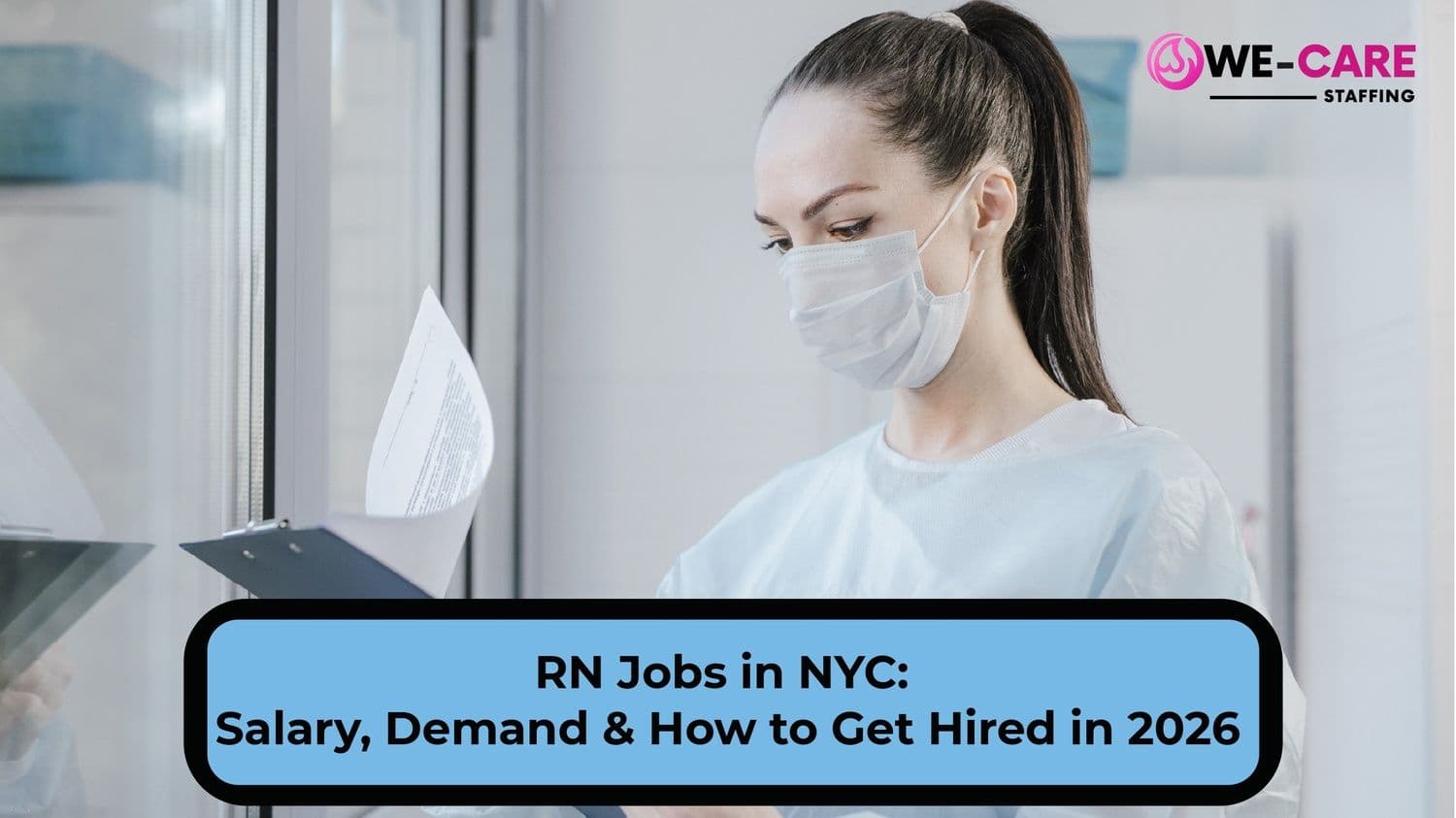
RN Jobs in NYC: Salary, Demand & How to Get Hired in 2026
New York City is the largest market for registered nurses in the United States. No metro area employs more RNs, and few offer the same density of world-class hospitals, specialties, and career paths. For nurses, that scale is the headline: more openings, more variety, and some of the highest nominal wages in the country. The catch is cost of living, which can quietly eat into a strong paycheck.

We Care Staffing
This guide covers what matters most if you're targeting RN jobs in NYC in 2026: what nurses actually earn, how strong demand really is, and a clear, step-by-step path to getting hired, including the licensing rules and local quirks (like New York's "BSN in 10" law) that catch newcomers off guard.
RN Jobs in NYC at a Glance (2026)

A quick snapshot before the detail:
- Market size: The New York–Newark–Jersey City metro is the number-one RN employment area in the country, with roughly 184,000 nurses working in the region.
- Pay: New York State's average (mean) RN wage is about $100,130 a year (BLS), and NYC sits at the top of the state's pay range.
- Demand: Workforce studies estimate more than 14,000 RN openings statewide each year, driven by growth and retirements.
- Outlook: RN employment in New York is projected to grow about 4.9% through 2034, in line with the national trajectory.
- Education: An ADN gets you licensed, but most NYC hospitals prefer a BSN, and state law requires you to earn one within 10 years of licensure.
RN Salary in NYC: What Nurses Actually Earn
How to read these numbers
Salary figures come from different places that measure different things, so it helps to know what you're looking at. The U.S. Bureau of Labor Statistics (BLS) publishes a mean (simple average) and a median (midpoint). Salary websites publish self-reported averages that often run higher or lower depending on who responded. None is definitively "correct," so treat the figures below as reliable ranges and pay more attention to the patterns than to any single number.
NYC vs New York State vs national
Nationally, the median RN wage was $93,600 a year as of May 2024, with the lowest 10% under about $66,030 and the top 10% above roughly $135,320 (BLS). New York pays well above that national midpoint. The statewide RN mean is about $100,130, and BLS data put the typical New York range from roughly $77,930 at the 10th percentile to $153,420 at the 90th.
Within the state, New York City pays at the high end. NYC nurses generally earn more than upstate peers, partly to offset the city's cost of living and partly because large, often-unionized health systems compete hard for staff. Once shift differentials, overtime, and union-negotiated raises are added in, many staff RNs at major NYC hospitals earn above the state average. Advanced practice roles go far higher, with nurse anesthetists (CRNAs) in New York averaging well over $200,000.
What raises NYC RN pay
Several factors push a nurse toward the upper end of the range:
- Experience: Pay climbs steadily with years on the job and with lead or charge-nurse responsibilities.
- Specialty: High-acuity areas like ICU, ER, OR, labor & delivery, and oncology typically pay more than general med-surg.
- Shift differentials and overtime: Nights, weekends, and holidays carry premiums; NYC's 24-hour hospitals offer plenty of these.
- Union contracts: Many NYC hospitals are represented by the New York State Nurses Association (NYSNA). Contract negotiations in recent years have delivered meaningful wage increases and safe-staffing commitments.
- Per diem / PRN and travel: Independent and short-term roles often pay higher hourly rates, trading benefits and stability for flexibility and pay.
Cost-of-living reality check

Here's the asterisk on every NYC salary. New York's cost of living runs well above the national average. By one widely cited index, it is around 25% higher statewide, and considerably more inside the city. After adjusting for what it costs to live there, NYC's strong nominal wages buy less than they appear to. That doesn't make NYC a bad choice; it makes cost-adjusted thinking essential when you compare an NYC offer against one elsewhere.
RN Demand in NYC: Is It a Good Market in 2026?
Why demand is strong
Demand for nurses in New York is durable and broad-based. Statewide openings are estimated at more than 14,000 a year, fueled by an aging population, rising chronic-disease rates, and a steady wave of retirements thinning the existing workforce. New York City concentrates a huge share of the state's hospitals and health systems, so the sheer number of employers makes it one of the easier large markets in which to land a role, especially for nurses open to a range of settings.
Where the openings are
Hospitals remain the largest employer of RNs, but openings span home health, ambulatory and outpatient care, long-term care, public health, and specialty clinics. High-acuity hospital specialties tend to have the steadiest demand and the strongest pay. New grads will find the most structured entry points through hospital nurse-residency programs (more on those below).
The honest caveat
"Shortage" doesn't mean every job is easy to get. Competitive specialty and magnet-hospital roles in Manhattan can draw many applicants, and some employers still prefer experience or a BSN. The shortage is most acute in long-term care, certain outer-borough and upstate settings, and hard-to-fill specialties, which is often where new nurses find their fastest path in.
How to Get Hired as an RN in NYC (2026)

A clear, ordered path from student to hired nurse in New York City:
Step 1: Earn your nursing degree (ADN or BSN)
You can become an RN with either an Associate Degree in Nursing (ADN) or a Bachelor of Science in Nursing (BSN). The ADN is faster and cheaper to start; the BSN is preferred by most NYC hospitals and is increasingly the baseline for competitive roles. Crucially, New York's "BSN in 10" law requires nurses to earn a BSN within 10 years of initial RN licensure, so even if you start with an ADN, plan for the bachelor's.
Step 2: Pass the NCLEX-RN
Every state, including New York, requires passing the National Council Licensure Examination for Registered Nurses (NCLEX-RN). Most candidates prepare for two to three months. Strong NCLEX prep matters; a first-attempt pass keeps your timeline and applications on track.
Step 3: Get licensed in New York
New York is unusual in that RN licensure is handled by the New York State Education Department (NYSED) Office of the Professions, not a standalone board of nursing. Also important for relocating nurses: New York is not a Nurse Licensure Compact state, so a multistate license from elsewhere won't cover you, so you must obtain a New York license directly. Build that processing time into your plans.
Step 4: Target the right employers
NYC's scale means a wide field of employers. Major systems include Northwell Health (the state's largest private employer), NYC Health + Hospitals (the public system serving all five boroughs), NewYork-Presbyterian, Mount Sinai Health System, NYU Langone Health, Montefiore, and Memorial Sloan Kettering. Applying across several systems, and across boroughs, widens your odds considerably.
Step 5: Use new-grad residencies and networking
If you're a new graduate, hospital nurse-residency programs are the most structured way in, since they pair you with training and mentorship and often convert to permanent roles. Beyond applications, networking through clinical rotations, nursing school alumni, and professional associations frequently surfaces openings before they're widely posted.
Step 6: Stand out
Make your application competitive: keep your BSN plan visible, pursue in-demand specialty certifications (for example BLS/ACLS, then specialty credentials as you grow), and tailor each application to the unit and setting. Flexibility on shift, borough, and specialty is one of the fastest ways for a new nurse to get a foot in the door.
Top NYC Health Systems Hiring RNs
Tips to Maximize Your NYC Nursing Career
- Lead with a BSN plan. It's preferred now and required within 10 years, so getting ahead of it improves both hiring odds and pay.
- Pick a high-demand specialty. ICU, ER, OR, and L&D tend to pay more and hire steadily.
- Use shift differentials. Nights and weekends in a 24-hour hospital can meaningfully raise annual earnings.
- Understand your union contract. If a role is NYSNA-represented, know the pay scale and staffing terms.
- Think cost-adjusted. Compare offers on what's left after rent, not just gross salary, since an outer-borough or commuter option may net more.
- Work with a healthcare staffing partner who knows the NYC market and can match you to the right system, specialty, and contract type.
Conclusion
For registered nurses, New York City offers what no other market can match at the same scale: the most RN jobs in the country, deep specialty options, strong union-supported wages, and a clear, if competitive path to getting hired. The one discipline that separates a good NYC nursing career from a great one is cost-adjusted thinking: know what your paycheck actually buys before you sign.
Ready to explore your options? Browse current RN openings in New York and connect with a recruiter who can match you to the right system and specialty before demand fills the best roles.
Have questions about working with a staffing agency for the first time? Our FAQ page covers the most common ones.
References & Sources
All data points are drawn from the following publicly available sources (accessed June 2026). BLS is the authoritative baseline; salary-site figures vary by methodology.
- U.S. Bureau of Labor Statistics — Registered Nurses, Occupational Outlook Handbook (national median $93,600, May 2024; 5% projected growth 2024–34; ~189,100 annual openings): https://www.bls.gov/ooh/healthcare/registered-nurses.htm
- BLS — Occupational Employment & Wage Statistics, Registered Nurses (state and metro wage tables): https://www.bls.gov/oes/current/oes291141.htm
- AllNursingSchools — Registered Nurse Salary, New York (state mean ~$100,130; range $77,930–$153,420; NYC metro #1 by employment; ~14,000 annual openings; top employers): https://www.allnursingschools.com/registered-nursing/salary/new-york/
- Nursa — RN Salary in New York (BLS-based percentiles, hourly wages, per diem context): https://nursa.com/salary/rn/new-york
- NurseJournal — NYC Nursing Salaries (NYC metro context; CRNA and specialty pay): https://nursejournal.org/new-york/nyc-nursing-salaries/
- New York State Education Department — Office of the Professions, Nursing (licensure): https://www.op.nysed.gov/professions/registered-professional-nursing
- New York State Nurses Association (NYSNA): https://www.nysna.org
Questions
Frequently asked
Looking for your next assignment?
Browse current travel contracts, or tell a recruiter what you are after and we will match you against roles before they are listed.