California RN License by Endorsement: A Travel Nurse's Guide
California is the highest-paying travel nursing market in the country, and it is also the one that costs the most nurses their start dates. The reason is simple: California does not accept a multistate compact license, and its Board of Registered Nursing is one of the slower boards in the nation. Nurses who apply late lose contracts. Nurses who apply early, and apply correctly, get the assignment.

We Care Staffing
This guide walks through the California RN license by endorsement process exactly as the Board of Registered Nursing (BRN) defines it, with the practical sequencing that matters for travelers on a contract timeline. If you're already looking ahead to assignments, you can browse current California RN openings with We Care Staffing while your application is in process.
Why Travel Nurses Need a California License
California has not joined the Nurse Licensure Compact (NLC). That single fact drives everything else in this guide. If you hold a multistate compact license, it does not authorize you to practice in California. Every travel nurse must hold either a full California RN license or a valid California temporary license before day one of an assignment.
There's an upside to this friction. Because the licensing barrier limits how quickly nurses can enter the state, demand stays high and California pay stays strong. The nurses who plan ahead are the ones who benefit from it. If you're weighing California against other markets while you decide, our travel nursing program overview explains how assignments and pay packages work.
Endorsement vs Examination: Which Applies to You
The BRN offers two paths, and travelers almost always need the first.
Licensure by endorsement applies if you already hold a current, active RN license in another U.S. state, a U.S. territory, or Canada. To qualify you must also have completed a nursing education program meeting California's requirements and have passed the NCLEX-RN or the older State Board Test Pool Examination (SBTPE).
Licensure by examination applies to new graduates who have never held an RN license.
Two important details straight from the BRN that catch people out: the Canadian Comprehensive Examination is not accepted, and if you have never taken and passed an RN examination in any state, you cannot be licensed by endorsement in California, even if your original state didn't require an exam. In those cases you must apply by examination instead.
The Endorsement Process, Step by Step
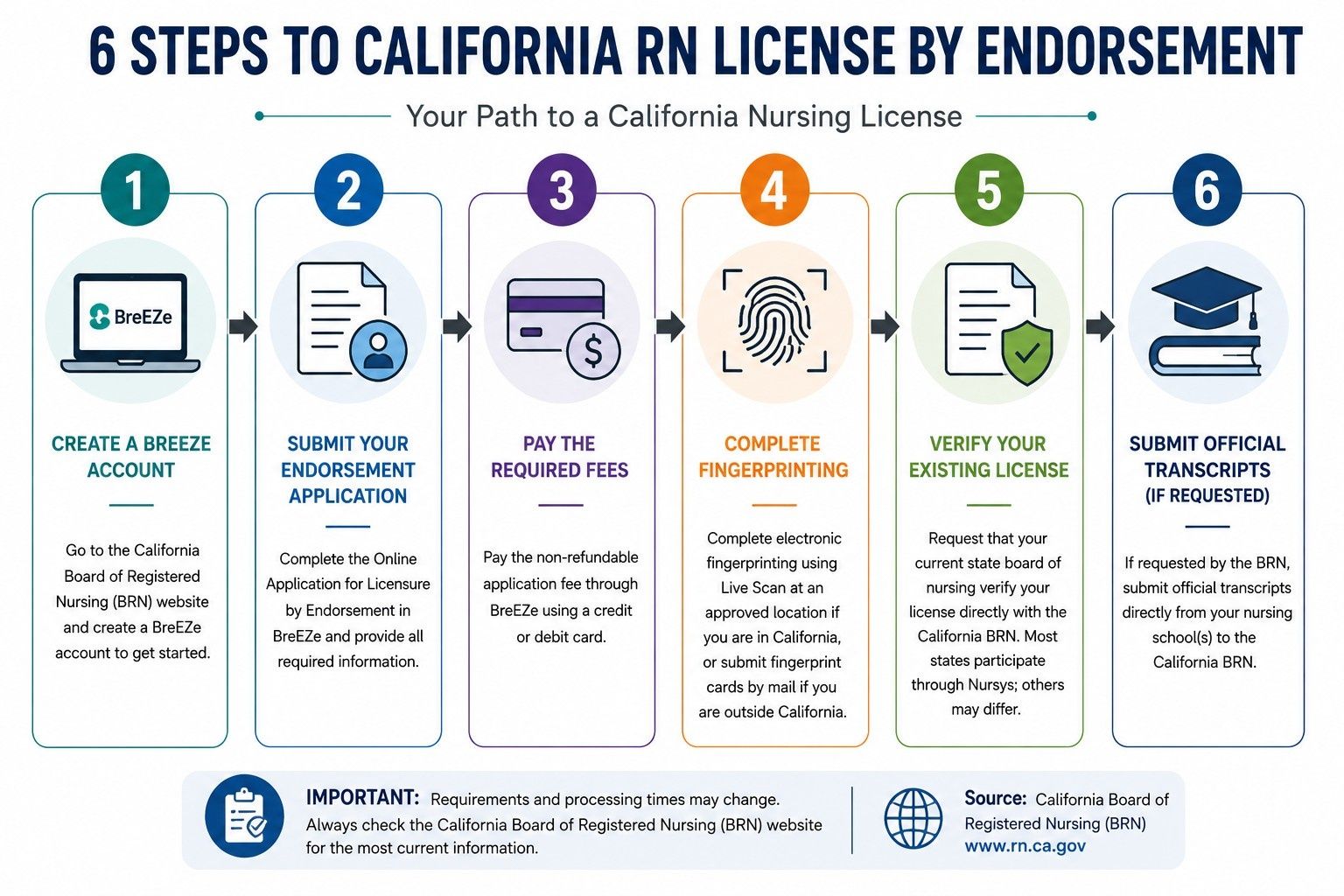
Step 1: Create a BreEZe account and apply online
All California licensing runs through BreEZe, the Department of Consumer Affairs online portal at breeze.ca.gov. Register for an account, then select "RN Endorsement" from the "Start a New Application or Take an Exam" dropdown.
The BRN explicitly recommends applying online rather than on paper, and warns that if you have already submitted a paper application, you should not also submit an electronic one, because duplicates slow everything down.
Step 2: Attach every supporting document you can
At the end of the online application you'll be able to upload documents. This is the highest-leverage step in the entire process. The Board's own guidance is to attach as much as possible up front, specifically to reduce paperwork, speed review, and cut down on deficiency letters. A deficiency letter is the single most common cause of multi-week delays.
If you have any prior discipline on another healthcare license, attach the explanation letter, letters of recommendation, out-of-state discipline documents, and any rehabilitation information along with your application rather than waiting to be asked.
Step 3: Pay your fees
Fees are paid by credit card through BreEZe at the time of submission. Budget roughly $350 for the endorsement application and about $100 more if you add a temporary license, plus fingerprinting costs. Fees change, so confirm current amounts on the BRN's official application fees page before you apply.
Step 4: Complete fingerprinting
Every applicant must submit fingerprints for a criminal background check through the California Department of Justice and the FBI. You have two options:
- Live Scan, the electronic method, if you are physically in California. This is faster and more reliable.
- Hard card (FD-258) fingerprinting if you're applying from out of state. This is the slower path and commonly adds several weeks.
Note that the application packet does not include a Live Scan form or hard card. You have to request those separately through the BRN's fingerprint information page, so do it at the start rather than after you submit.
Step 5: Verify your existing license
The BRN needs official verification of the RN license you already hold. If your state board participates in Nursys, you can complete this electronically. If not, you'll submit a completed "Verification of License" form.
Here is a timing trap worth memorizing: Nursys verifications expire 90 days from the date of request, and the BRN specifically warns not to request yours before you submit your endorsement application. Request it too early and it can expire before your file is fully evaluated, forcing you to redo and repay.
Step 6: Get your transcripts sent
If you attended a nursing program outside California, transcripts can be sent electronically through a certified vendor such as Parchment or the National Student Clearinghouse, or directly from your school, to the BRN's electronic transcripts address. International program graduates must have official transcripts mailed and will have additional forms to complete.
Schools are often slow. Request transcripts on day one of the process, not after the Board asks for them.
The Temporary License: A Traveler's Best Tool
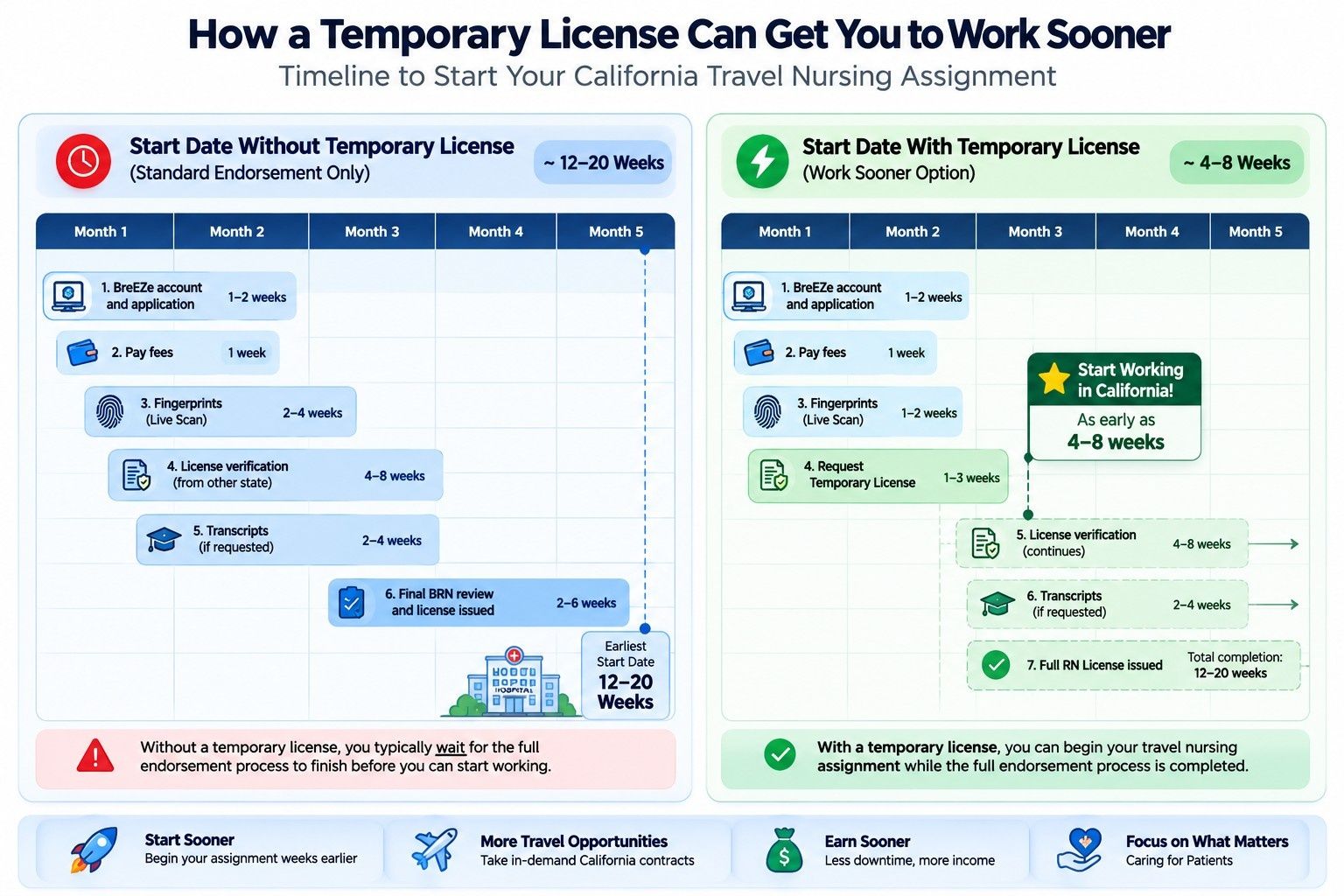
This is where several competing guides get it wrong, so it's worth being precise. California does offer a temporary license to endorsement applicants. The BRN's own endorsement instructions state that you may apply online for a temporary license if you wish to begin work while your permanent license is being issued.
For a travel nurse, this can be the difference between starting a contract on schedule and losing it. The practical guidance:
- Submit your endorsement application first, since the temporary license request follows it.
- Apply for the temporary license at the same time, not later, so nothing is sequential that doesn't have to be.
- Expect it to be issued only after your fingerprint background check clears.
- Confirm current temporary license terms, fees, and validity period on the BRN's temporary license page, since board policies change.
If you'd like help sequencing this alongside a specific assignment, our recruiters do it constantly. You can contact our team to get your licensing and contract timelines lined up.
The 2023 Coursework Exemption (A Real Time-Saver)
One of the most useful recent changes, and one many nurses don't know about: effective October 1, 2023, California added CCR section 1410.5, a coursework exemption for out-of-state applicants.
Previously, many experienced nurses were told to retake anatomy, physiology, or microbiology because their original courses lacked a laboratory component. That requirement was a well-known barrier. Under the exemption, if you have completed the theory component of anatomy, physiology, and microbiology, and you have been practicing in good standing for at least two years in another U.S. state or territory, you are no longer required to retake those courses with a lab.
To use it, complete the Board's Coursework Exemption Attestation Form and upload it through BreEZe under "Submit Additional Documents." There's no fee, and review takes roughly two weeks. One caveat directly from the BRN: if your transcripts or out-of-state license verification are still missing, the Board cannot process your exemption request, so get those in first.
How Long Does It Take?
Timelines vary with volume and with how clean your application is. In practice, a well-prepared endorsement application commonly takes about eight to fourteen weeks, and applications with missing documents, hard-card fingerprints, name mismatches, or disclosure items can run considerably longer.
Rather than relying on any blog's estimate, including this one, use the Board's official Processing Times page, which shows the application dates currently being reviewed. Compare that to your submission date and you can estimate your own wait fairly accurately. You can also track your file at any time through your BreEZe account or the Application Status portal.
The practical rule for travelers: start three to four months before your target start date. That single habit prevents most licensing disasters.
Common Delays and How to Avoid Them
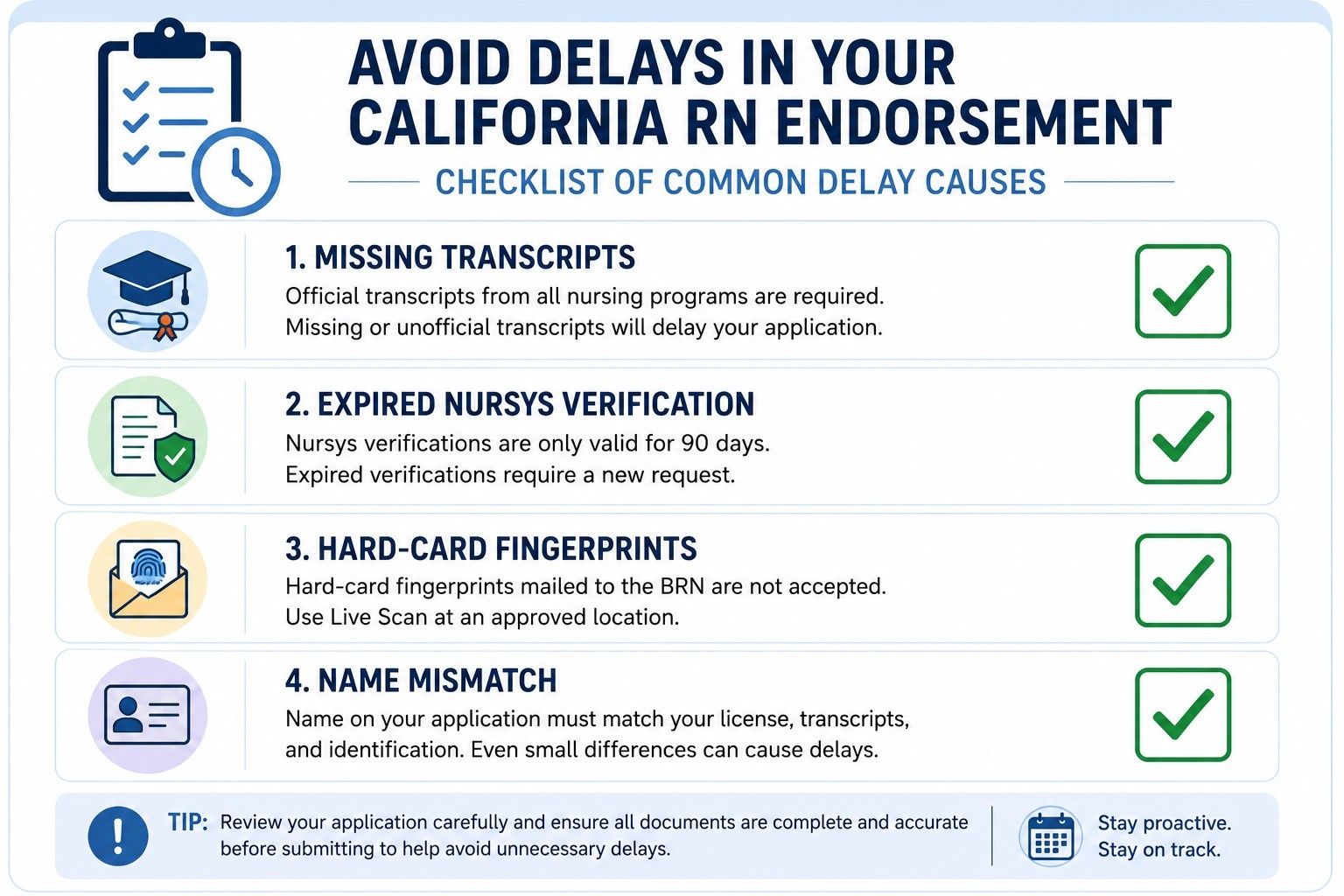
Nearly every long wait traces back to one of these:
- Incomplete submissions. Documents trickling in after the application stalls your file. Attach everything up front.
- Requesting Nursys verification too early. It expires in 90 days. Submit your application first.
- Hard-card fingerprints. Unavoidable from out of state, but plan for the extra weeks and send them immediately.
- Slow school transcripts. Request them the day you decide to apply.
- Name mismatches. A maiden name on a transcript against a married name on the application forces manual review. Include documentation of any name change.
- Waiting on the coursework exemption. Submit transcripts and verification first, or the Board can't evaluate the exemption at all.
- Applying on paper, or twice. Apply online only, and never duplicate a paper application electronically.
After You're Licensed
Once your California license is issued, keep it in good standing. California requires 30 hours of continuing education every two years, and licenses renew on a two-year cycle. Since travel assignments move you between states, staying on top of CE and renewal dates matters more than it does for staff nurses in one place.
With your license active, you're eligible for one of the strongest travel markets in the country, from Bay Area academic centers to Los Angeles and San Diego hospitals. You can start comparing California RN assignments here. If you're also weighing other non-compact destinations, Hawaii travel assignments and Alaska RN roles involve similar advance-planning logic.
Conclusion
Getting a California RN license by endorsement isn't difficult, but it is unforgiving of poor sequencing. California isn't a compact state, the Board is slow, and a single missing transcript can cost you a contract. Apply online through BreEZe, attach everything at submission, handle fingerprints immediately, request Nursys verification only after you apply, use the 2023 coursework exemption if you qualify, and add the temporary license so you can start working sooner. Do those things three to four months ahead, and California's premium assignments become genuinely accessible.
Ready to plan your California assignment? Browse current California RN jobs and start your BRN endorsement now so your license is ready when the right contract opens.
References & Sources
All process details are drawn from official sources (accessed June 2026). The California BRN is the authoritative baseline; verify fees and timelines there before applying.
- California Board of Registered Nursing — Licensure by Endorsement (eligibility, BreEZe application, fingerprints, Nursys 90-day rule, transcripts, temporary license, CCR 1410.5 coursework exemption): https://www.rn.ca.gov/applicants/lic-end.shtml
- California BRN — Temporary License Information: https://www.rn.ca.gov/applicants/lic-temp.shtml
- California BRN — Processing Times: https://www.rn.ca.gov/times.shtml
- California BRN — Application Fees: https://www.rn.ca.gov/consumers/fees.shtml
- California BRN — Fingerprint Information: https://www.rn.ca.gov/applicants/fpinstruct.shtml
- BreEZe Online Licensing Portal (California DCA): https://www.breeze.ca.gov
- Nursys — License Verification: https://www.nursys.com
- Nurse Licensure Compact (NLC) — participating states: https://www.nursecompact.com
Questions
Frequently asked
Looking for your next assignment?
Browse current travel contracts, or tell a recruiter what you are after and we will match you against roles before they are listed.