

12x3 vs 5x8 vs 3x12 vs 48-Hour: A Complete Guide to Travel Healthcare Contract Schedules
Before you sign a travel contract, one line in it shapes your entire assignment: the schedule. It determines how many days you work, how long each day runs, how much you earn, and how tired you'll be by the end of a 13-week stretch. The shorthand can look cryptic, 3x12, 12x3, 5x8, 48s, and the wrong choice for your life can turn a great-paying contract into a miserable one.

We Care Staffing
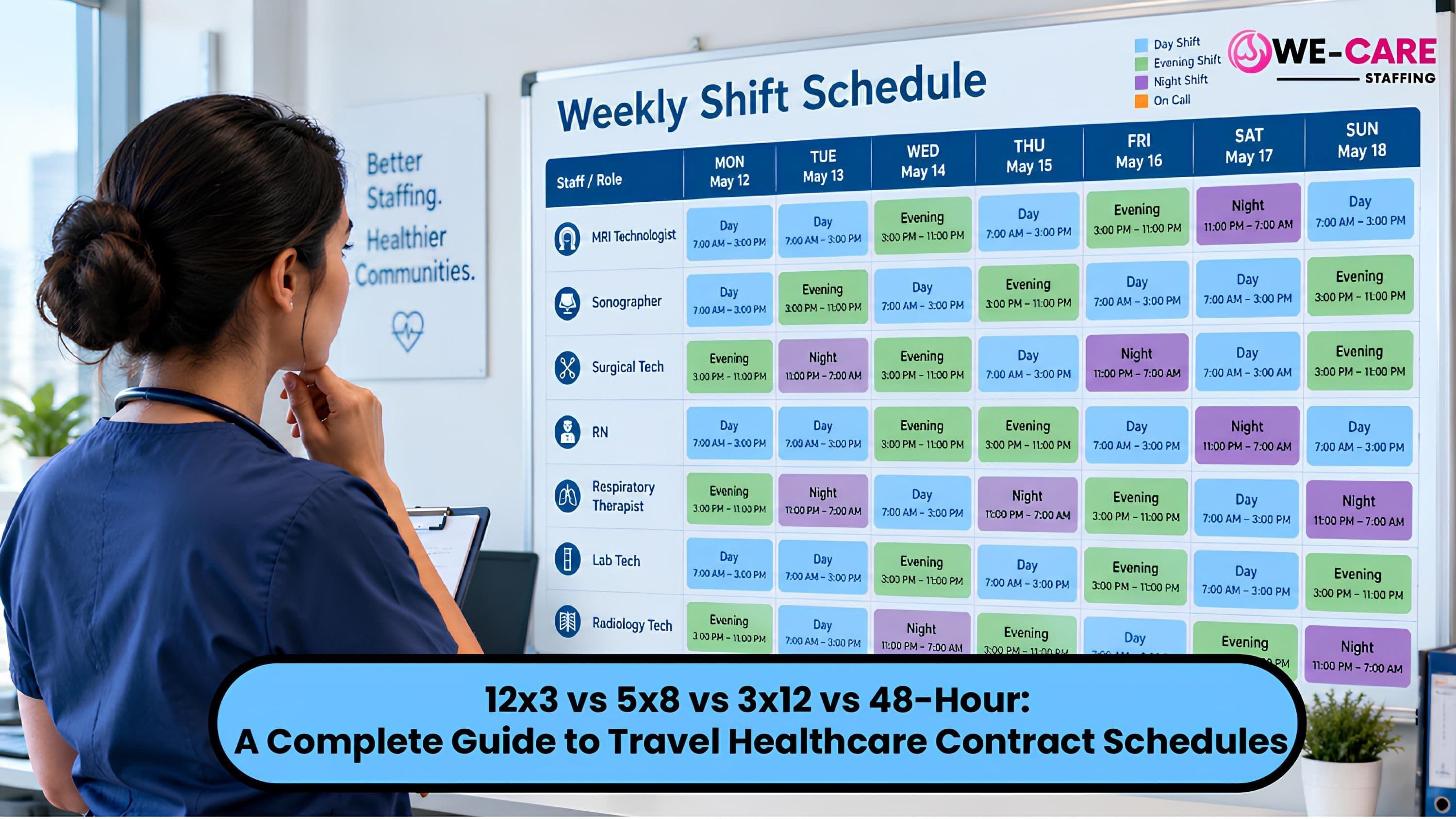
This complete guide decodes travel healthcare contract schedules, explains what each one really means for your pay and your wellbeing, and helps you choose the right fit. We'll also clear up a common point of confusion right away (yes, 12x3 and 3x12 are the same thing). If you're weighing assignments, you can explore our travel nursing program as you read.
First, Let's Decode the Notation
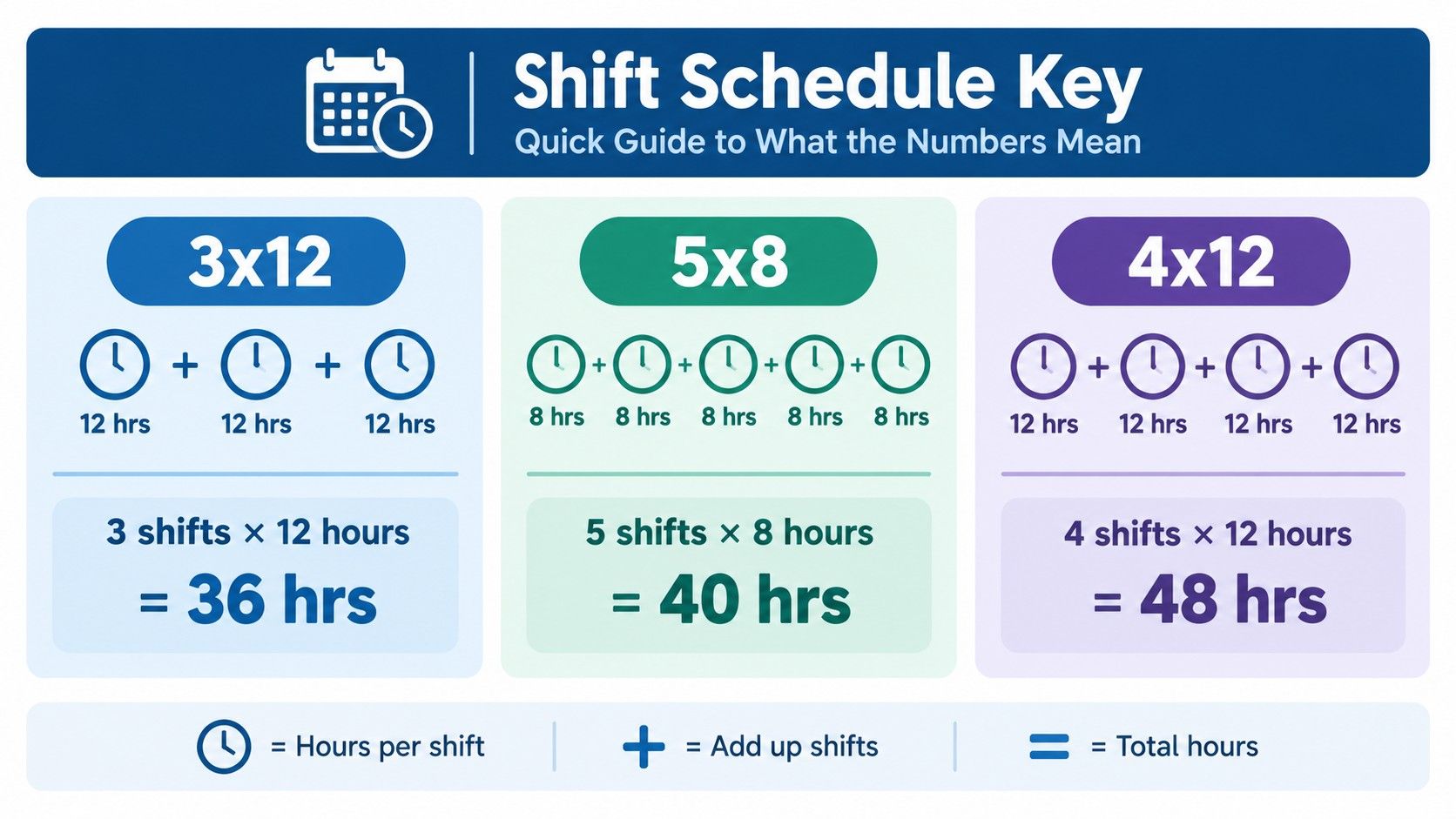
The shorthand is simpler than it looks once you know the pattern. It's just (number of shifts) and (length of each shift), and the two numbers get written in either order:
- 3x12 (or 12x3): three 12-hour shifts per week = 36 hours. These are the same schedule, just written differently. "3x12" (three twelves) is the more common way to write it, but "12x3" means exactly the same thing. Neither means twelve 3-hour shifts.
- 5x8: five 8-hour shifts per week = 40 hours.
- 4x12: four 12-hour shifts per week = 48 hours. This is what most people mean by a "48-hour contract."
So the honest framing of this comparison is really three distinct weekly structures, 36 hours (3x12), 40 hours (5x8), and 48 hours (4x12), since 12x3 and 3x12 are one and the same. Everything that follows is about those three real options.
Quick Comparison Table
Here's the landscape at a glance.
The 3x12 (36-Hour) Schedule: The Travel Standard
Three 12-hour shifts is the classic travel healthcare schedule, and for good reason.
The upside. You work three days and have four days off every week. That's the single biggest lifestyle advantage in travel healthcare: long stretches to explore your assignment city, host visitors, travel home, or simply recover. It's why so many clinicians choose travel in the first place, and why 3x12 is the default many travelers prefer.
The trade-off. Twelve-hour shifts are long, and three in a row (or clustered together) can be physically and mentally demanding, especially in high-acuity units. And at 36 hours, your gross weekly pay is the baseline of the three structures, lower than a 48, though many travelers find the extra time off well worth it.
Best for: nurses and allied professionals who prioritize time off, work-life balance, and the freedom to actually enjoy where they're assigned.
The 5x8 (40-Hour) Schedule: Steadier Days, Less Time Off
Five 8-hour shifts is less common in travel nursing but more common in some allied health roles (imaging, lab, therapy, clinic settings) and certain facilities.
The upside. Eight-hour shifts are less fatiguing per day than twelves, with a more traditional daily rhythm. For some people, five shorter days are easier on the body than three marathon ones, and 40 hours pays a bit more gross than 36.
The trade-off. You're on-site five days a week, leaving only two days off, which sharply cuts the travel-and-explore advantage that draws many people to travel healthcare. You're more tied to the standard workweek.
Best for: clinicians who prefer shorter daily shifts, work in specialties where 8s are standard, or don't mind trading days off for a lighter daily load.
The 48-Hour (4x12) Schedule: Maximum Pay, Maximum Demand on You

Four 12-hour shifts, 48 hours a week, is the high-earner's schedule, and it comes with real trade-offs.
The upside. More hours mean more money, and crucially, the hours beyond 40 typically pay overtime (more on that below), which is why 48-hour contracts often have an outsized effect on your weekly total. If your primary goal is to maximize earnings in a short window, 48s are the fastest way there. You still get three days off.
The trade-off. Forty-eight hours of high-acuity clinical work, week after week for 13 weeks, is demanding, and the burnout and fatigue risk is the highest of the three. The extra pay is real, but so is the toll. Many travelers who love 48s in theory find them exhausting in practice by the back half of a contract.
Best for: clinicians chasing maximum short-term income who can genuinely sustain the workload without compromising safety or wellbeing.
How Your Schedule Affects Your Pay
This is where the schedule choice hits your wallet, and where two concepts matter most.
Blended rate, not headline rate. Travel pay combines a taxable base wage with tax-free housing and meal stipends. Because stipends are usually a fixed weekly amount, working more hours can actually lower your effective hourly blended rate even as your gross pay rises. Always compare the total weekly package divided by hours worked, not just the base rate.
Overtime on 48-hour contracts. In most cases, hours worked beyond 40 in a week are paid at time-and-a-half, which is a big part of why 48-hour contracts pay so well, that back 8 hours carries a premium. Overtime rules vary by state, and a few states have additional protections. California, for example, has daily overtime (time-and-a-half after 8 hours in a day, double time after 12) on top of weekly overtime, which makes long-shift math there more favorable still. Always confirm exactly how a contract defines and pays overtime before signing.
The honest bottom line on pay: a 48 grosses the most, a 36 the least, and a 40 sits between, but time off, sustainability, and your blended rate matter as much as the gross number. The highest-paying schedule isn't automatically the best-paying decision for you.
Guaranteed Hours: The Clause That Matters Most
Whatever schedule you pick, one contract term can make or break it: guaranteed hours.
A guaranteed-hours clause means you get paid for your full contracted hours even if the facility cancels a shift for low census (low patient volume). Without it, a hospital can call off your shift, and you simply don't get paid for those hours. Over a slow week, that can cost you hundreds or thousands of dollars.
A few essentials:
- Confirm your hours are guaranteed and read exactly how the clause works. Some contracts guarantee all hours; others cap how many times you can be canceled.
- Requesting time off can void the guarantee for that week. If you ask for days off, the facility often isn't obligated to pay you the weekly minimum for that week.
- Watch the flip side of "48 guaranteed." A guarantee can also obligate you to be available for all 48 hours. Understand what you're committing to, not just what you're owed.
Guaranteed hours are often more important to your actual take-home than the difference between a 36 and a 40. Never skip this line.
Block Scheduling and Self-Scheduling
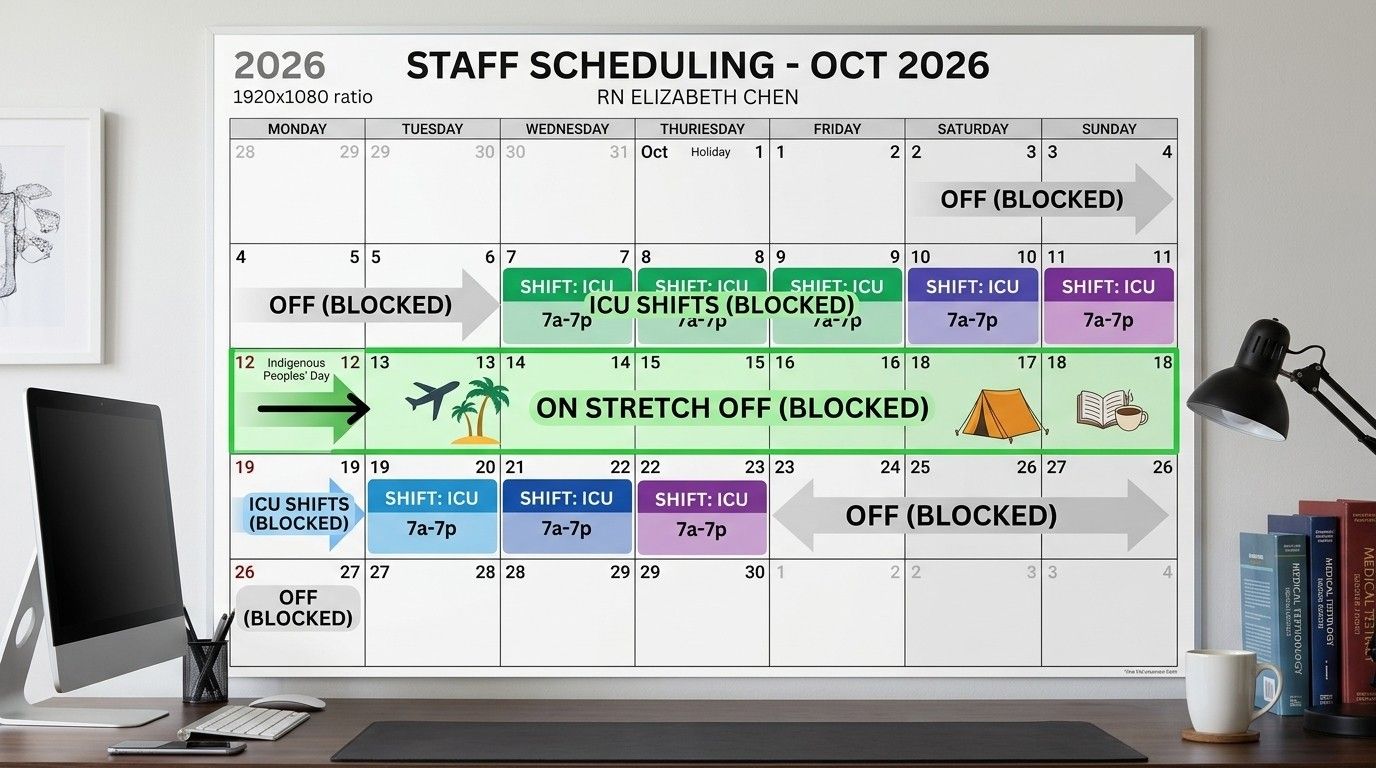
Beyond how many hours, how your shifts are arranged matters enormously.
Block scheduling means grouping your shifts together, for example, working your three 12s back-to-back so you get four consecutive days off. For travelers, this is gold: it creates long stretches to travel, rest, or explore. But it's usually not guaranteed unless negotiated, and back-to-back 12s are also more tiring, so it's a trade-off. If block scheduling matters to you, ask your recruiter to request it in writing before you sign.
Self-scheduling vs assigned shifts. Some contracts let you self-schedule (choose your shifts within the unit's needs); others assign them. Self-scheduling gives you more control over your daily life on assignment, so it's worth asking which applies.
Because these details are negotiable and easy to overlook, a good recruiter is genuinely valuable here. If you'd like help lining up a schedule that fits your life, reach out to our team.
How to Choose the Right Schedule for You
- Lead with sustainability, not just pay. The best schedule is the one you can work well for the whole contract without burning out.
- If time off is your priority, 3x12 with block scheduling is hard to beat, four days off, long stretches to enjoy your assignment.
- If maximizing income is the goal, a 48 grosses the most thanks to overtime, if you can truly sustain the hours.
- If long shifts wear you down, 5x8 trades days off for a lighter daily load.
- Always confirm guaranteed hours and overtime terms in writing, they affect real take-home more than the schedule label.
- Ask about block and self-scheduling if daily-life control matters to you.
Red Flags to Watch in a Contract
- No guaranteed hours, or a vague cancellation clause. This is the biggest financial risk.
- Unclear overtime treatment on a 48-hour contract. If the OT isn't spelled out, ask.
- Penalties that fall only on you. Be wary if the facility can cancel you freely but you face steep penalties for any change.
- "Guaranteed 48" without clarity on whether that protects your pay, obligates your hours, or both.
- Verbal promises not in writing. Block scheduling, requested days off, and shift type should all be in the contract, not just discussed.
Conclusion
Your contract schedule shapes everything about a travel assignment: your paycheck, your energy, and how much you actually enjoy where you land. Remember that 3x12 and 12x3 are the same 36-hour schedule; that 5x8 (40 hours) trades days off for lighter days; and that a 48-hour week grosses the most thanks to overtime but asks the most of you. Then look past the schedule label to the terms that truly drive your take-home and wellbeing, guaranteed hours, overtime treatment, and block scheduling. Choose the structure you can sustain, confirm the fine print in writing, and a good schedule becomes one of the best parts of travel healthcare. When you're ready, explore our travel nursing program and allied health staffing services, and let a recruiter help you find a contract that fits your life.
References & Sources
All information reflects standard travel-healthcare contract practice as described by the following sources (accessed June 2026). Contract terms and overtime rules vary by agency, facility, and state; always confirm specifics in your own contract.
- Trusted Health — Travel nurse contracts guide (schedule, hours, guaranteed hours, cancellation clauses): https://www.trustedhealth.com/travel-nursing-guide/travel-nurse-contracts
- Medical Solutions — Types of travel nursing assignments (36 vs 48 hours, shift types): https://www.medicalsolutions.com/blog/clinician/different-types-of-travel-nursing-assignments/
- Triage Staffing — Block scheduling for nurses (block scheduling benefits and trade-offs): https://triagestaff.com/blog/block-scheduling-for-nurses/
- BluePipes — Travel nursing shifts and contract length (guaranteed-hours cautions, cancellation realities): https://blog.bluepipes.com/travel-nursing-assignments-considerations-for-shifts-and-contract-length/
- California Department of Industrial Relations — Overtime rules (state overtime context, e.g., daily OT): https://www.dir.ca.gov/dlse/faq_overtime.htm
- U.S. Bureau of Labor Statistics — Registered Nurses (baseline pay context): https://www.bls.gov/ooh/healthcare/registered-nurses.htm
Questions
Frequently asked
Looking for your next assignment?
Browse current travel contracts, or tell a recruiter what you are after and we will match you against roles before they are listed.