
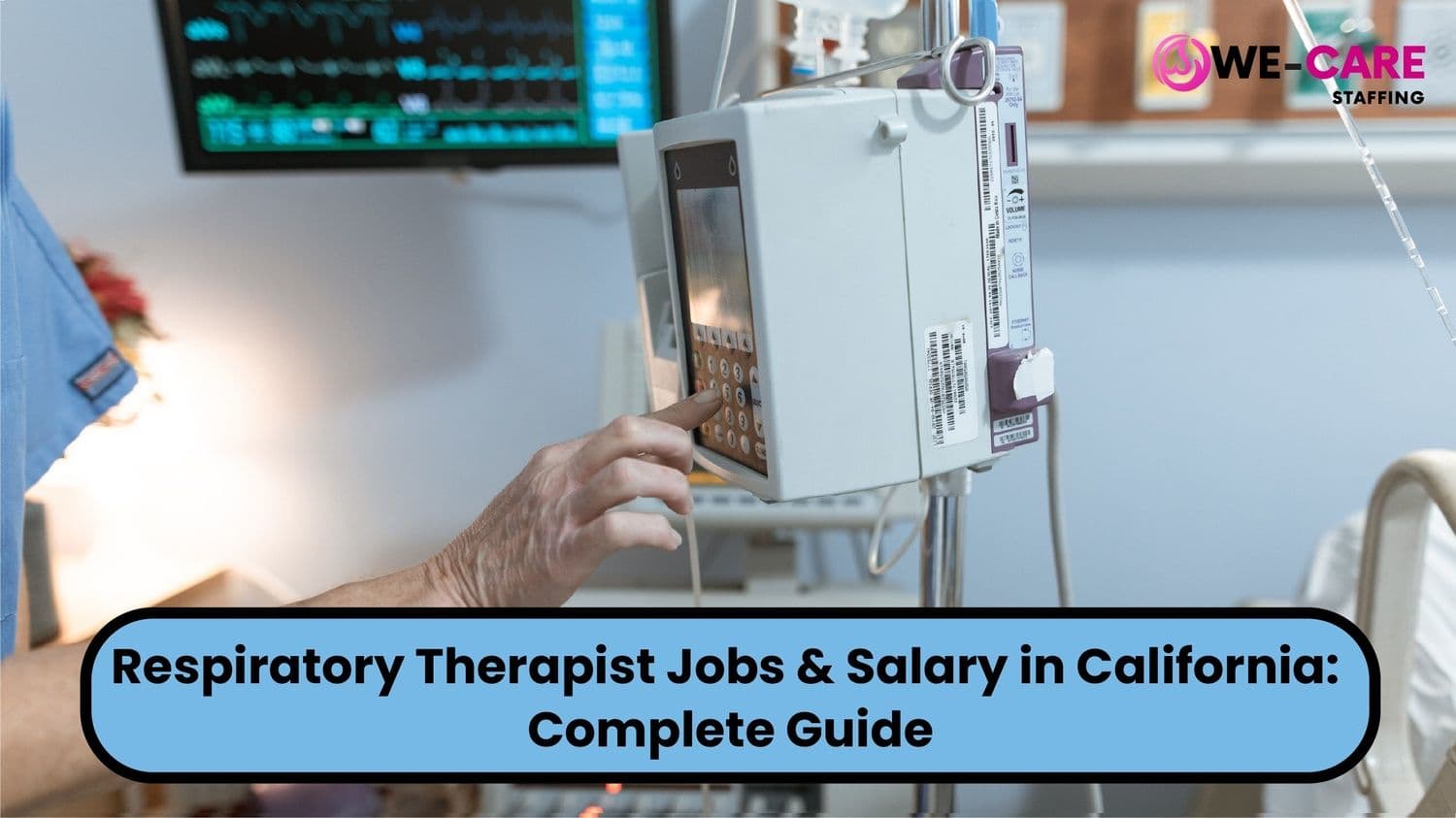
Respiratory Therapist Jobs & Salary in California: Complete Guide
California is the best-paying state in the country for respiratory therapists, and it employs more of them than anywhere else. If you're weighing this career, planning a move to the state, or trying to figure out where in California your paycheck goes furthest, this guide pulls the real numbers together in one place: what respiratory therapists actually earn, how pay differs by city and setting, how strong demand is, and the exact licensing path to practice in California.

We Care Staffing
Everything below is anchored in current federal wage data, with the honest context you need to read those numbers correctly. Because a high respiratory therapist salary in California comes with an equally high cost of living, the smartest read of this guide is a cost-adjusted one.
Respiratory Therapist Salary in California at a Glance (2026)
California pays respiratory therapists more, on average, than any other state. Here's the snapshot, drawn from the U.S. Bureau of Labor Statistics (BLS):
- California average (mean) wage: about $102,120 a year, or roughly $49.10 an hour (BLS, May 2024), the highest state figure in the nation.
- Typical California range: from about $78,150 at the 10th percentile to $138,000 at the 90th, with the middle half between roughly $90,700 and $125,800.
- National median for comparison: about $80,450 a year ($38.68 an hour), so California pays well above the U.S. norm.
- Employment: California employs more respiratory therapists than any other state, and nationally the field held about 139,600 jobs in 2024.
How to Read These Salary Numbers
Before the city breakdown, one clarification that saves a lot of confusion. BLS publishes a mean (a simple average) and a median (the midpoint), while salary websites publish self-reported averages that can run higher or lower depending on who responded. That's why you'll see California figures quoted anywhere from the $80,000s to well over $100,000 across the web. The BLS numbers in this guide are the authoritative baseline. Treat everything as a reliable range, and weigh the patterns, which cities and settings pay more, more heavily than any single dollar figure.
Respiratory Therapist Salary in California by City

Pay varies sharply across the state, and the pattern is clear: the Bay Area and Sacramento region sit at the top, while the Central Valley and some inland metros sit lower. The figures below are median annual wages from BLS (May 2024), so half of therapists in each area earn more and half earn less.
The Bay Area tops the list, but it also carries the state's highest housing costs, so a $137,000 median in San Jose buys less than it appears to. Sacramento is the standout on value: a median near $129,000 paired with living costs well below the coast. Los Angeles and San Diego offer huge job markets at solid, if more moderate, pay.
What Affects Respiratory Therapist Pay in California
Five factors move a respiratory therapist's earnings more than anything else.
Credential: CRT vs RRT
Respiratory therapists earn national credentials through the National Board for Respiratory Care (NBRC). The Certified Respiratory Therapist (CRT) is the entry-level credential; the Registered Respiratory Therapist (RRT) is the advanced one. Most California employers prefer, and many require, the RRT, and it generally supports higher pay and better roles.
Experience
Pay rises steadily with time on the job and with lead, charge, or supervisory responsibilities. Moving into management (respiratory care supervisor, manager, or director) is one of the largest single jumps in earning power available in the field.
Work setting
Hospitals employ the large majority of respiratory therapists and tend to anchor pay, with critical care, emergency, and neonatal intensive care units among the most demanding and best-compensated environments. Skilled nursing facilities, home health, and physicians' offices round out the field, often with different pay and schedule trade-offs.
Shift differentials, per diem, and travel
Because hospitals run around the clock, nights, weekends, and holidays carry premium pay. Per diem and travel respiratory therapists frequently earn higher hourly rates in exchange for less predictable schedules and fewer benefits, which can be a fast way to raise income.
Location and cost of living
The map matters twice: once for the nominal salary, and again for what that salary is worth. The Bay Area pays the most but costs the most; Sacramento and parts of the inland state offer the strongest cost-adjusted value. Always compare offers on what remains after housing, not just the headline number.
Respiratory Therapist Job Demand & Outlook in California
Demand is strong and durable. Nationally, BLS projects respiratory therapist employment to grow 12% from 2024 to 2034, much faster than the average for all occupations, with about 8,800 openings each year over the decade. Growth is driven by an aging population and the rising prevalence of respiratory conditions such as COPD, pneumonia, and asthma, along with a continued shift toward outpatient and home-based care.
California, as the largest employer of respiratory therapists in the country and home to a large, aging population, mirrors that strength. Openings span hospitals, skilled nursing and long-term care, home health, and outpatient clinics, giving both new graduates and experienced therapists a broad market to work in.

How to Become a Respiratory Therapist in California
California requires a state license to practice, on top of national credentials. Here's the path.
Step 1: Earn an accredited degree
Complete a respiratory therapy program accredited by the Commission on Accreditation for Respiratory Care (CoARC). An associate degree is the minimum, though many therapists earn a bachelor's degree, which can widen job and advancement options.
Step 2: Earn your NBRC credential
Pass the National Board for Respiratory Care (NBRC) examinations to earn the CRT and then the RRT. Because most California hospitals prefer the RRT, plan to pursue it even if you start by earning the CRT.
Step 3: Get licensed by the Respiratory Care Board of California
To practice in California you must hold a Respiratory Care Practitioner (RCP) license issued by the Respiratory Care Board of California (RCBC). Apply once your education and NBRC credentialing are in order, and build the processing time into your job-search plan.
Where Respiratory Therapists Work in California
Hospitals are by far the largest employer, and California's major health systems, including Kaiser Permanente, Sutter Health, Dignity Health, UC health systems, Cedars-Sinai, and others, hire respiratory therapists across critical care, emergency, pulmonary, and neonatal units. Beyond hospitals, therapists work in skilled nursing facilities, home health, sleep-disorder clinics, physicians' offices, and patient-transport roles. That spread means you can often shape your career around either high-acuity hospital work or more predictable outpatient schedules.
How to Increase Your Respiratory Therapist Salary in California
A few deliberate moves reliably raise earning power:
- Earn the RRT. The advanced NBRC credential is preferred by most California employers and supports higher pay.
- Add specialty credentials. NBRC specialty certifications (for example in neonatal/pediatric or sleep-disorder care) can open better-paid roles.
- Target high-paying metros. If cost of living allows, the Bay Area and Sacramento region pay the most; weigh the pay against housing.
- Use shift differentials and per diem. Nights, weekends, and per diem work carry premiums that add up over a year.
- Move toward leadership. Supervisor, manager, and director roles offer some of the largest pay increases in the field.

Conclusion
California offers respiratory therapists the highest pay in the country, a deep and growing job market, and a clear (if multi-step) path to licensure. The one discipline that turns a strong salary into real financial progress is cost-adjusted thinking: knowing what your pay is actually worth after California's high housing costs. Earn the RRT, target the right metro for your budget, and use differentials and leadership moves to climb, and a respiratory therapist career in California can be both stable and genuinely well paid.
Ready to start? Compare current respiratory therapist openings across California by city and setting, run a cost-adjusted salary comparison, and target the credentials and roles that move you toward the top of the range.
References & Sources
All data points are drawn from the following publicly available sources (accessed June 2026). BLS is the authoritative baseline; salary-site figures vary by methodology.
- U.S. Bureau of Labor Statistics — Respiratory Therapists, Occupational Outlook Handbook (national median ~$80,450, May 2024; 12% projected growth 2024–34; ~8,800 annual openings; ~139,600 jobs in 2024): https://www.bls.gov/ooh/healthcare/respiratory-therapists.htm
- O*NET OnLine / BLS OEWS — Respiratory Therapists, California wages (state mean ~$102,120; percentile and metro-level median wages, May 2024 data): https://www.onetonline.org/link/localwages/29-1126.00?st=CA
- BLS — Occupational Employment & Wage Statistics, Respiratory Therapists (state and metro tables): https://www.bls.gov/oes/current/oes291126.htm
- Respiratory Care Board of California (RCP licensure): https://www.rcb.ca.gov
- National Board for Respiratory Care (CRT/RRT credentials): https://www.nbrc.org
- Commission on Accreditation for Respiratory Care (CoARC, accredited programs): https://www.coarc.com
- American Association for Respiratory Care (AARC, profession resources): https://www.aarc.org
Questions
Frequently asked
Looking for your next assignment?
Browse current travel contracts, or tell a recruiter what you are after and we will match you against roles before they are listed.