
Registered Nurse Jobs in Wisconsin: Milwaukee vs Madison Pay
Wisconsin is a solid, steady market for registered nurses, and it comes with an advantage that high-pay states like California and New York can't offer: it's a compact license state, so many out-of-state nurses can start working without a separate application. Pay sits near the middle of the pack nationally, cost of living is reasonable, and between the state's two anchor markets, Milwaukee and Madison, there's a real and useful pay difference worth understanding before you sign.

We Care Staffing

This guide compares registered nurse jobs in Wisconsin across Milwaukee and Madison, using current Bureau of Labor Statistics data. You'll see how pay differs between the two metros, how the compact license works, and an honest look at which city leaves you better off once cost of living is factored in. If you're already exploring roles, you can browse current Wisconsin RN openings with We Care Staffing as you read.
Wisconsin Is a Compact State: What That Means
Here's the practical advantage up front. Wisconsin is a member of the Nurse Licensure Compact (NLC). It was one of the original compact states back in 2000 and adopted the Enhanced Nurse Licensure Compact (eNLC) in 2017, administered through the Wisconsin Department of Safety and Professional Services (DSPS) and its Board of Nursing.
What that means in practice:
- If you hold a multistate compact license from another NLC state, you can generally practice in Wisconsin without a separate Wisconsin license, as long as Wisconsin isn't your primary state of residence.
- If you move to Wisconsin permanently, you have 30 days from establishing residency to apply for a Wisconsin license.
- If you're from a non-compact state or hold a single-state license, you apply for a Wisconsin license by endorsement through DSPS.
For travel nurses and those relocating from compact states, this is a genuine time-saver: no multi-week licensing wait between you and a start date. It's the opposite of the situation in California, New York, or Oregon, where a standalone license is mandatory.
Registered Nurse Salary in Wisconsin
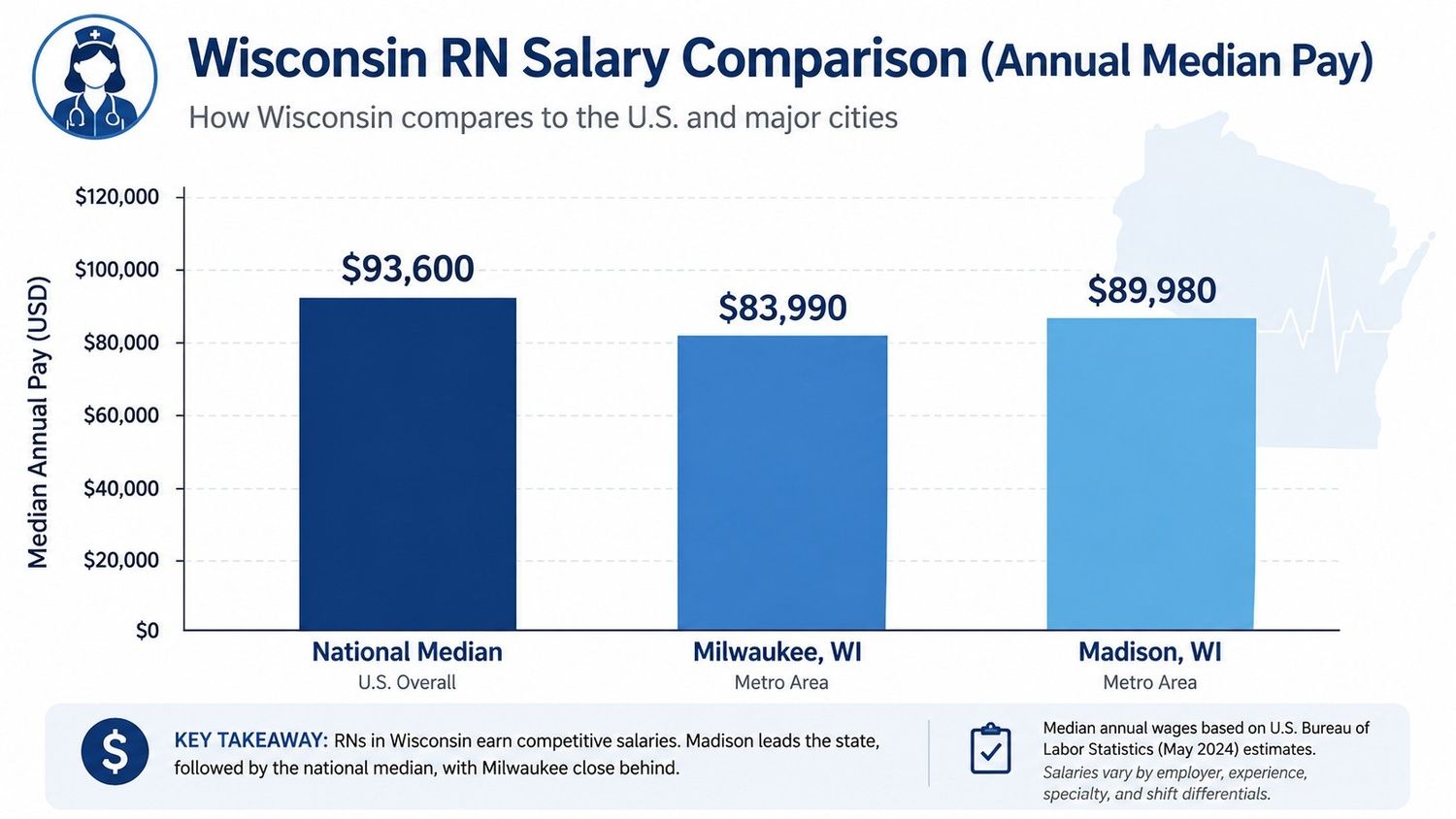
Wisconsin RN pay sits a bit below the national median, but the state's reasonable cost of living softens that gap. Based on U.S. Bureau of Labor Statistics (BLS) OEWS data (2024):
- Wisconsin average (mean) wage: about $87,220 a year
- Typical range: from about $69,240 at the 10th percentile to $105,110 at the 90th
- National median for comparison: $93,600 (BLS, May 2024)
- Employment: roughly 68,000 RNs statewide, a large and stable workforce
So a typical Wisconsin RN earns in the mid-to-high $80,000s on average, slightly under the national median but well-supported by a cost of living that tracks close to the national average. A note on the numbers: BLS publishes a mean and a median, and salary websites report self-reported averages that vary, so treat these as reliable ranges. The BLS data is the authoritative baseline.
Milwaukee vs Madison: How Pay Compares
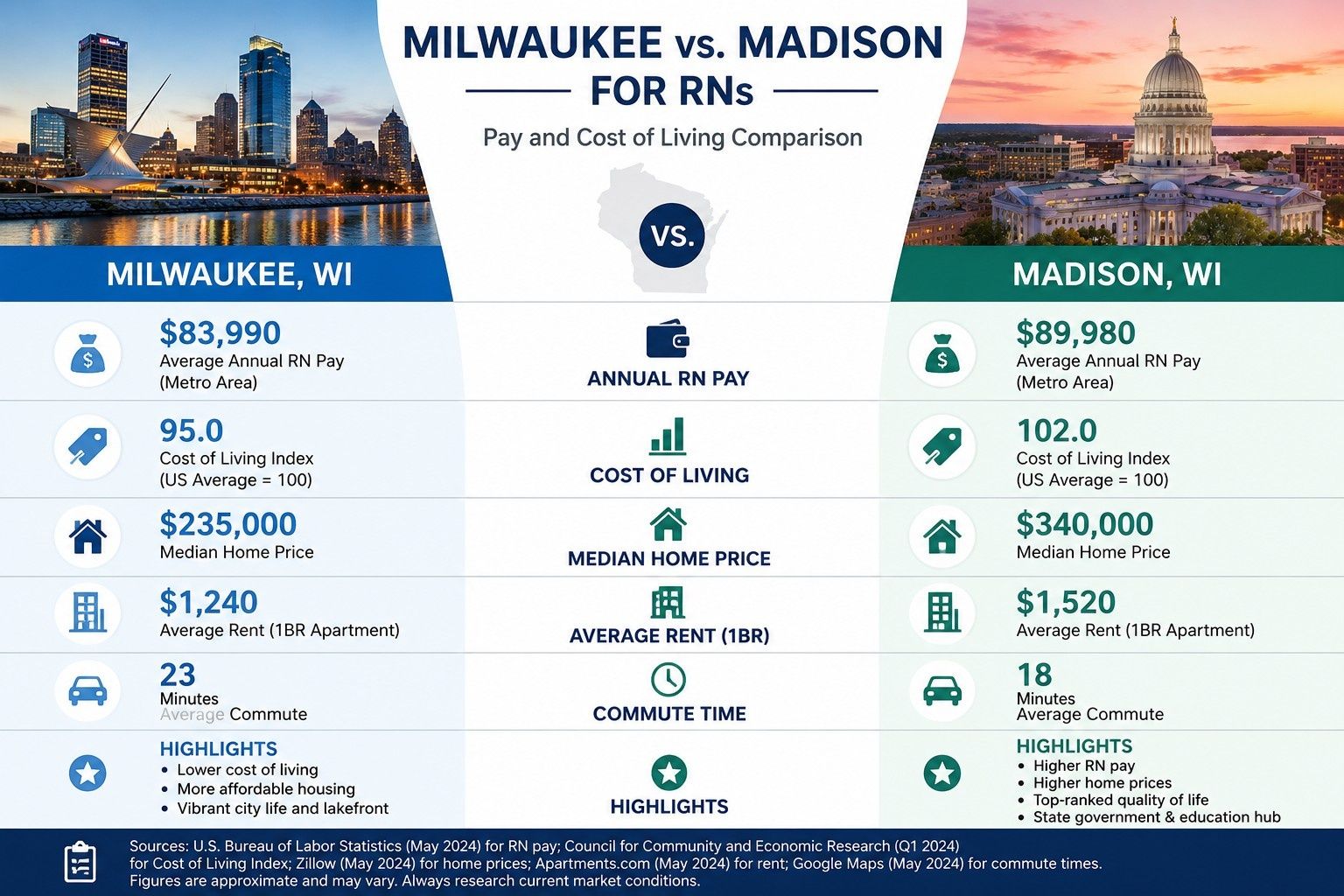
This is where the comparison gets interesting, because the smaller city actually pays more.
Madison, the state capital and home to the University of Wisconsin, is Wisconsin's highest-paying metro for nurses. BLS-based data puts the Madison average around $100,430 a year, meaningfully above the state average and the highest of any Wisconsin metro. Madison's pay is driven by major academic and health systems, including UW Health and University Hospital, along with UnityPoint Health-Meriter and SSM Health. It's a smaller, highly educated city with strong quality of life.
Milwaukee, the state's largest city and biggest healthcare market by volume, tends to pay somewhat below Madison at the average, despite being the larger metro. Milwaukee is anchored by major systems including Froedtert and the Medical College of Wisconsin, Ascension Wisconsin, and Aurora Health Care (part of Advocate Health). It offers the widest variety of specialties, acuity levels, and sheer number of openings in the state.
The honest takeaway: Madison pays more on average, while Milwaukee offers more jobs and specialty variety. Madison's cost of living is a bit higher than Milwaukee's, so the real gap narrows somewhat once housing is factored in, but Madison generally still comes out ahead on nominal RN pay. Which city is "better" depends on whether you prioritize the highest average pay and a smaller-city feel (Madison) or the widest job selection and a larger urban market (Milwaukee).
Head-to-Head: Milwaukee vs Madison
Treat pay figures as directional, since metro wages vary by source and survey year.
Nurse Demand and Outlook in Wisconsin
Demand is steady and broad. Nationally, BLS projects RN employment to grow about 5 to 6 percent over the decade, and Wisconsin mirrors that, driven by an aging population and ongoing healthcare expansion. Openings span hospitals, ambulatory and outpatient care, home health, and long-term care, with the largest concentrations in the Milwaukee and Madison metros and steady demand in Green Bay, Appleton, and the Eau Claire area.
Because Wisconsin is a compact state, nurses from other compact states can move in quickly to meet that demand, which makes it an especially accessible market for travelers. Explore current Wisconsin RN roles here.
How to Maximize Your Wisconsin Nursing Career
- Use the compact advantage. If you hold a multistate license, Wisconsin is one of the faster markets to start in, so line up contracts accordingly.
- Weigh Madison vs Milwaukee on your priorities. Madison for the highest average pay, Milwaukee for the most jobs and specialty variety.
- Target high-acuity specialties. ICU, ER, OR, and L&D tend to pay more and hire steadily, especially in academic centers.
- Factor in cost of living. Wisconsin's near-average living costs mean its RN pay stretches reasonably well, so run the cost-adjusted math on any offer.
- Consider travel or per diem. Contract roles can be a fast way to test a Wisconsin market, and the compact makes entry easy.
- Keep credentials current. Certifications and continuing education support higher pay and more selective roles.
Conclusion
Wisconsin offers registered nurses a genuinely practical package: solid pay, a reasonable cost of living, and compact license access that makes it one of the easier states to start working in. Between the two anchor markets, Madison delivers the highest average RN pay in the state and a smaller-city lifestyle, while Milwaukee offers the widest job selection and specialty variety in a larger urban market. Run the cost-adjusted math, use the compact advantage if you have it, and choose the metro that matches your goals. When you're ready, browse current Wisconsin RN jobs across Milwaukee, Madison, and beyond.
References & Sources
All data points are drawn from the following publicly available sources (accessed June 2026). BLS and the Wisconsin DSPS are the authoritative baselines; salary-site figures vary by methodology.
- U.S. Bureau of Labor Statistics — Registered Nurses, Occupational Outlook Handbook (national median $93,600, May 2024; ~5% growth 2024–34): https://www.bls.gov/ooh/healthcare/registered-nurses.htm
- BLS OEWS Wisconsin data — Registered Nurses (state average $87,220; range $69,240–$105,110; ~68,000 employed; 2024 estimates): https://americabynumbers.com/salary/registered-nurses-salary-in-wisconsin/
- Wisconsin metro RN wage data (Madison ~$100,430), BLS-based regional reporting: https://www.rippling.com/blog/registered-nurse-salary-wisconsin
- Wisconsin Department of Safety and Professional Services (DSPS) — Registered Nurse licensure and compact status: https://dsps.wi.gov/Pages/Professions/RN/Default.aspx
- Nurse Licensure Compact (NLC) — participating states (confirming Wisconsin is a member): https://www.nursecompact.com
- NursingLicensure.org — Wisconsin license requirements and eNLC details: https://www.nursinglicensure.org/state/nursing-license-wisconsin/
Questions
Frequently asked
Looking for your next assignment?
Browse current travel contracts, or tell a recruiter what you are after and we will match you against roles before they are listed.