Registered Nurse Jobs in Pennsylvania: Philadelphia vs Pittsburgh Salary Guide
Pennsylvania is one of the largest nursing markets in the country, anchored by two very different big cities, world-class academic medicine in both, and a piece of news that changes the picture for travel nurses: as of July 2025, Pennsylvania is a compact license state. Pay sits near the national average, cost of living is reasonable across most of the state, and between Philadelphia and Pittsburgh there's a genuine debate about which metro actually pays nurses more.

We Care Staffing

This guide compares registered nurse jobs in Pennsylvania across Philadelphia and Pittsburgh, using current Bureau of Labor Statistics data. You'll see how pay stacks up between the two metros (including an honest look at where the data disagrees), how the new compact license works, and which city leaves you better off once cost of living is factored in. If you're already exploring roles, you can browse current Pennsylvania RN openings with We Care Staffing as you read.
Big News: Pennsylvania Is Now a Compact State (2025)
Here's a recent, important change many nurses haven't caught up with. Pennsylvania fully implemented the Nurse Licensure Compact (NLC) on July 7, 2025. After enacting the legislation in 2023, the state turned on compact privileges in mid-2025, administered through the Pennsylvania Department of State's Board of Nursing.
What that means in practice:
- Nurses with a multistate compact license from another NLC state can now practice in Pennsylvania without obtaining a separate Pennsylvania license.
- Pennsylvania residents can now apply for a multistate license through the state's PALS system, letting them practice across all compact states.
- Existing PA licenses were marked "single-state" when the compact went live, so PA-resident nurses who want multistate privileges need to apply for the upgrade.
For travel nurses, this is a meaningful upgrade: Pennsylvania went from requiring its own license to being an easy, low-friction market to enter, joining the majority of states. It's a genuine competitive advantage the state didn't have a couple of years ago. (Because implementation is recent, confirm current details on the PA Board of Nursing site.)
Registered Nurse Salary in Pennsylvania
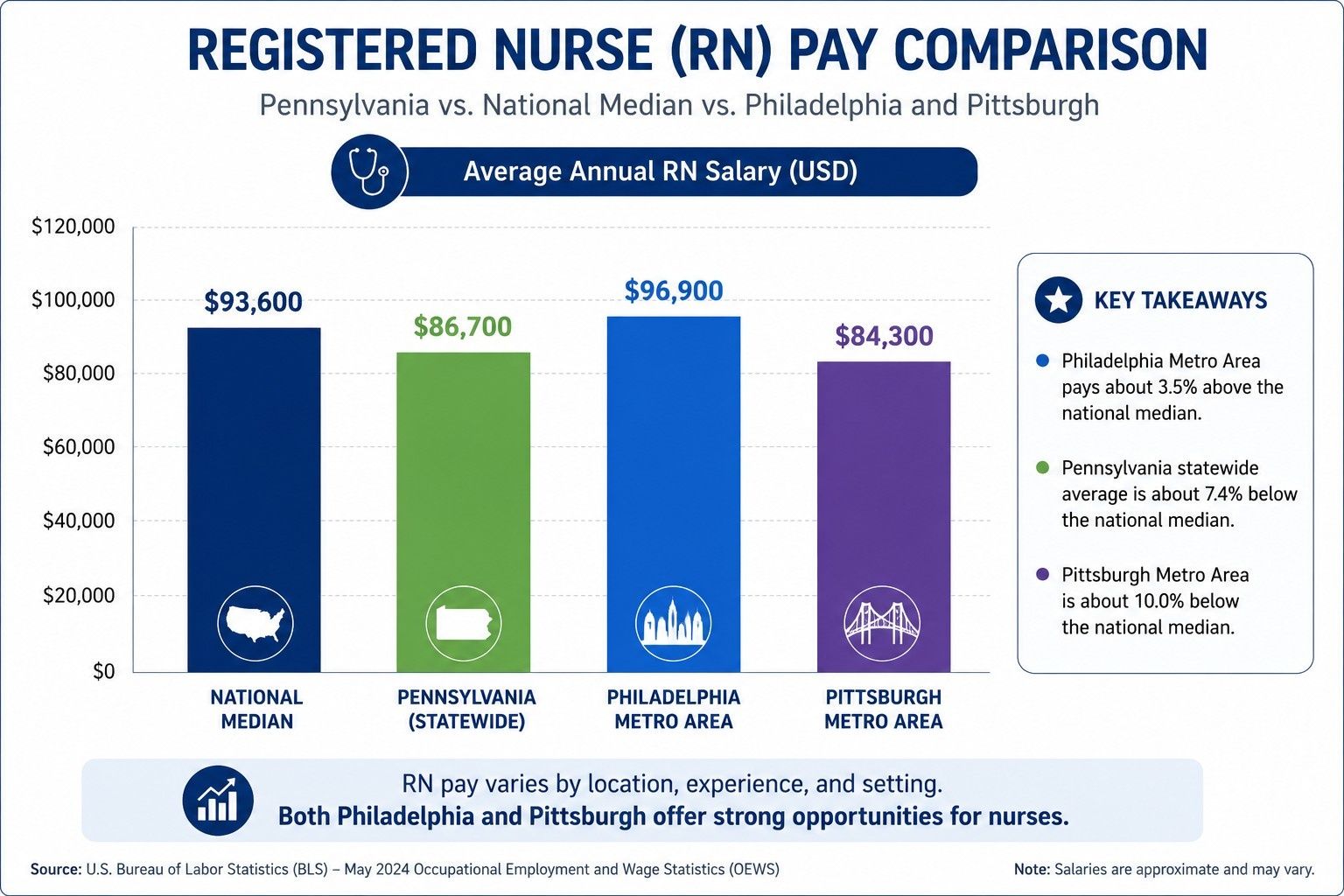
Pennsylvania RN pay sits a little below the national median, but a reasonable cost of living and a low flat state income tax help close the real-income gap. Based on U.S. Bureau of Labor Statistics (BLS) OEWS data (May 2024):
- Pennsylvania median wage: about $87,610 a year ($42.12 an hour)
- National median for comparison: $93,600 (BLS, May 2024)
- Typical range: roughly $65,700 to $104,200 for the middle half, with top earners clearing $130,000
- Employment: about 146,840 RNs statewide, placing Pennsylvania among the top five states for total RN employment
A useful bonus for take-home pay: Pennsylvania has a flat state income tax of just 3.07 percent, one of the lower state rates in the country, which stretches an RN salary further than in high-tax states. A note on the numbers: BLS publishes a mean and a median, and salary websites report self-reported averages that vary, so treat these as reliable ranges, with BLS as the authoritative baseline.
Philadelphia vs Pittsburgh: Where the Data Actually Disagrees
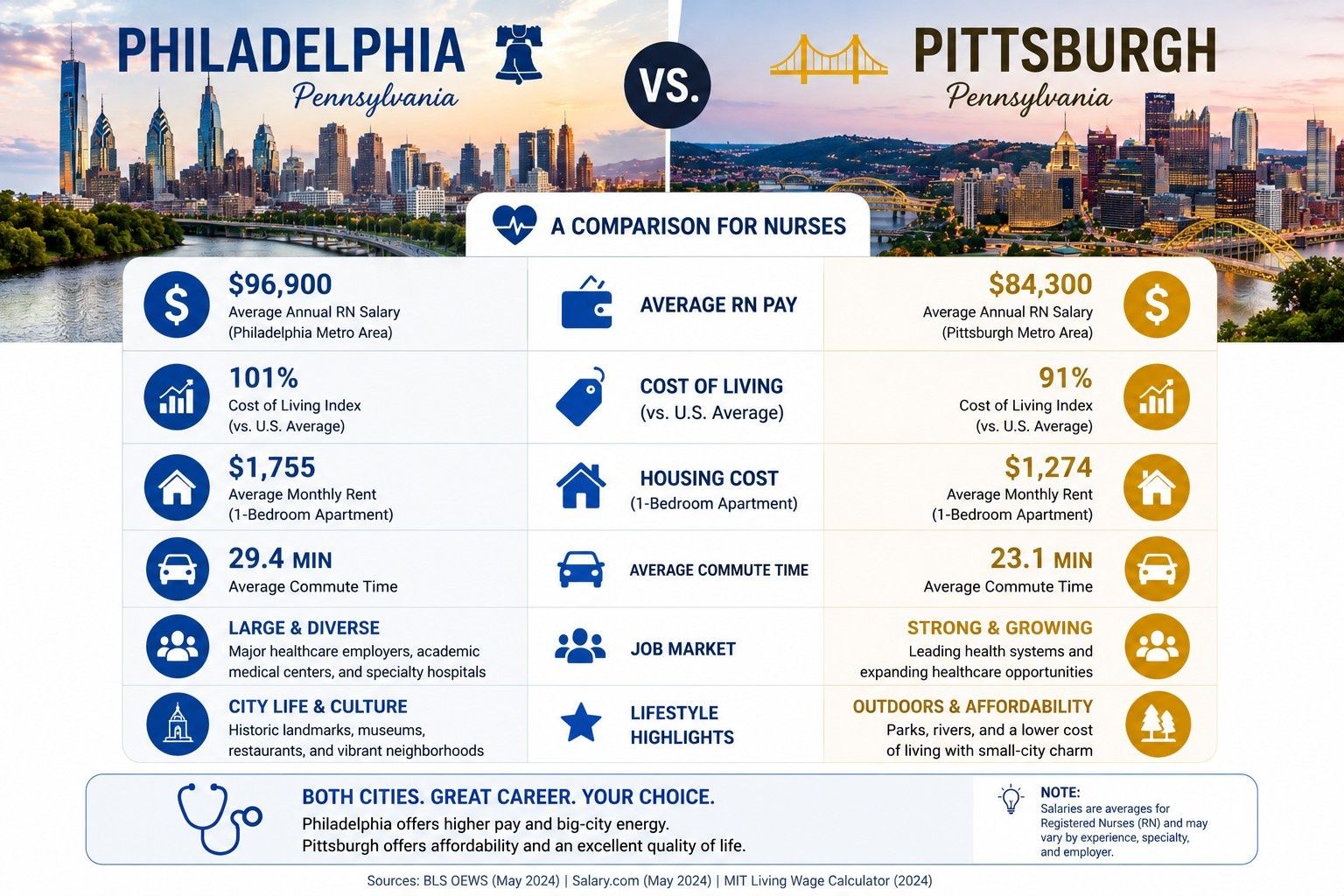
This is the interesting part, and honesty matters here: the sources genuinely disagree on which metro pays RNs more, so here's the real picture rather than a tidy but misleading single answer.
By BLS metro-average data, Philadelphia comes out ahead, with an average RN wage around $81,860 and by far the largest workforce in the state (roughly 73,500 RNs). Philadelphia is home to premier academic centers, including Penn Medicine, Jefferson Health, and Children's Hospital of Philadelphia (CHOP).
By market and staffing data, Pittsburgh often reads higher, with some 2026 sources putting the average RN salary around $97,000, roughly 10 percent above the state average, driven heavily by UPMC (one of the largest health systems in the country) and Allegheny Health Network. UPMC-specific pay data shows Pittsburgh staff RN averages well into the $120,000s.
Why the disagreement? Two reasons. First, methodology: BLS metro averages capture all RN roles, including community hospital and outpatient jobs that dilute Philadelphia's average despite its elite academic centers, while market data often skews toward large-system hospital roles. Second, timing and sample: salary sites weight recent, self-reported, hospital-heavy data differently.
The honest takeaway: both metros pay competitively and both host nationally ranked systems. Pittsburgh's cost of living is lower (a few percent below the national average), so its cost-adjusted value is often stronger, while Philadelphia offers the largest job market and the widest specialty mix. Rather than trust a single "winner," compare specific offers from specific systems.
Head-to-Head: Philadelphia vs Pittsburgh
Treat pay figures as directional, since sources and survey years differ.
What Affects RN Pay in Pennsylvania
Several factors move earnings within the state:
- Employer and system. Large academic systems (UPMC, Penn Medicine, Jefferson, CHOP) and magnet-designated hospitals pay at the top, especially for specialty roles.
- Specialty and certification. High-acuity units (ICU, ER, OR, L&D, oncology) pay more, and certifications like CCRN, CEN, and OCN commonly unlock annual stipends often in the low thousands.
- Shift differentials. Nights, weekends, and holidays add roughly a few dollars to $10-plus per hour at major systems, and night-shift RNs can add meaningful annual income through differentials.
- Experience and setting. Pay rises with tenure and leans higher in hospital settings than in some community or outpatient roles.
Nurse Demand and Outlook in Pennsylvania
Demand is strong and durable. Nationally, BLS projects RN employment to grow about 5 percent from 2024 to 2034, with roughly 189,100 openings a year, and Pennsylvania mirrors that, driven by an aging population, large hospital systems, and ongoing regional consolidation. Openings span hospitals, ambulatory and outpatient care, home health, and long-term care, concentrated in the Philadelphia and Pittsburgh metros with steady demand in the Lehigh Valley, Harrisburg, and central and rural PA. With the new compact status, nurses from other compact states can move in quickly to meet that demand. Explore current Pennsylvania RN roles here.
How to Maximize Your Pennsylvania Nursing Career
- Use the new compact status. If you hold a multistate license, Pennsylvania is now a fast market to enter, so line up contracts accordingly.
- Compare specific system offers, not city averages. Because the metro data disagrees, judge Penn Medicine vs UPMC offers directly.
- Target high-acuity specialties and certifications. ICU, ER, and OR roles plus CCRN/CEN certifications raise pay.
- Factor in cost of living and the low state tax. Pittsburgh's lower costs and PA's 3.07 percent flat tax both help real income.
- Use shift differentials. Nights and weekends add up meaningfully over a year.
- Consider travel or per diem. The compact makes short-term PA contracts easy to start.
Conclusion
Pennsylvania offers registered nurses a strong, practical package: near-average pay, a low flat state income tax, a reasonable cost of living, world-class academic systems in both major cities, and, as of 2025, compact license access that makes it far easier to start working. Between the two metros, Philadelphia offers the largest job market and leads on BLS metro-average pay, while Pittsburgh often reads higher in system and market data and delivers stronger cost-adjusted value. Because the data genuinely disagrees, the smartest move is to compare specific offers from specific systems rather than trust a single headline. When you're ready, browse current Pennsylvania RN jobs across Philadelphia, Pittsburgh, and beyond.
References & Sources
All data points are drawn from the following publicly available sources (accessed June 2026). BLS and the Pennsylvania Department of State are the authoritative baselines; salary-site figures vary by methodology.
- U.S. Bureau of Labor Statistics — Registered Nurses, Occupational Outlook Handbook (national median $93,600, May 2024; 5% growth 2024–34; ~189,100 annual openings): https://www.bls.gov/ooh/healthcare/registered-nurses.htm
- BLS OEWS Pennsylvania data — Registered Nurses (state median $87,610; ~146,840 employed; May 2024): https://wagebystate.com/registered-nurse/pennsylvania/
- Pennsylvania Department of State — Nurse Licensure Compact (full implementation July 7, 2025; multistate license via PALS): https://www.pa.gov/agencies/dos/department-and-offices/bpoa/boards-commissions/nursing/nlc
- Incredible Health — RN salary Pennsylvania and Philadelphia metro (Philadelphia average ~$81,860; ~73,500 RNs): https://www.incrediblehealth.com/salaries/rn/pa
- TAG MedStaffing — Pennsylvania RN salary guide 2026 (Pittsburgh market average ~$97,231; differentials, certifications): https://www.tagmedstaffing.com/blog/pennsylvania-nurse-salary-guide/
- Nurse Licensure Compact (NLC) — participating states (confirming Pennsylvania is a member): https://www.nursecompact.com
Questions
Frequently asked
Looking for your next assignment?
Browse current travel contracts, or tell a recruiter what you are after and we will match you against roles before they are listed.