
Physical Therapist Jobs in Alaska: Anchorage, Juneau & Bethel
Alaska suits a PT who is comfortable with autonomy, weather, and distance, and it rewards that PT with broad clinical scope and above-average pay. Anchorage is the largest city and the easiest transition. Juneau offers coastal small-city living on the Inside Passage. Bethel is a remote, fly-in regional hub with the most distinctive clinical and cultural experience. To practice, you need an Alaska physical therapist license or a valid compact privilege, since the state now participates in the Physical Therapy Compact. The U.S. Bureau of Labor Statistics (BLS) puts the Alaska median PT wage at $115,280 per year (May 2025), about 12% above the national median of $102,760.

We Care Staffing

Why Alaska Is Different for Physical Therapists
Most states offer a familiar mix of outpatient clinics and hospital rehab. Alaska adds geography. Many communities cannot be reached by road, patients may travel long distances for care, and clinicians often cover a wider scope than they would in a large urban system. For PTs who want to broaden their skills, that can be an advantage. For PTs who value predictability, it is worth planning for.
The three communities in this guide represent three different Alaska experiences, which is why the right choice depends on what you want from the job.
Anchorage, Juneau and Bethel at a Glance
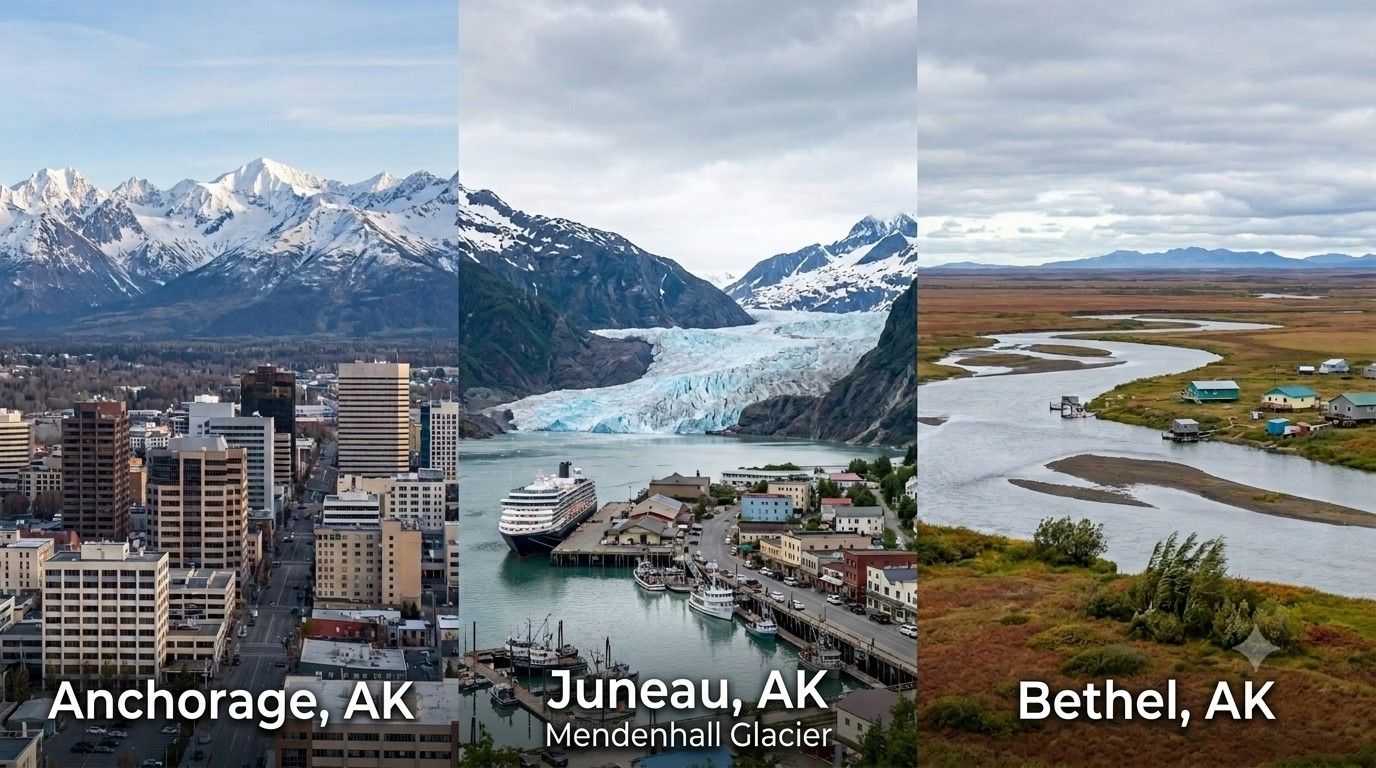
Anchorage
Anchorage is Alaska's largest city and the most common starting point for clinicians new to the state. It offers the widest range of settings, including hospital, outpatient, and home health work, plus the shopping, dining, and services you would expect from a larger city, with trails and mountains close by.
Juneau
Juneau is the state capital, set in coastal rainforest along the Inside Passage. It is a small city with striking scenery, glaciers, and whale watching, and it is reached by air or ferry.
Juneau suits PTs who want small-city living with the outdoors at the doorstep, and who are comfortable with a community that is not connected to the wider road network.
Bethel
Bethel is a regional hub on the Kuskokwim River serving communities across the surrounding region, many of them Alaska Native. Because Bethel is a fly-in community, plan your travel, supplies, and downtime in advance.
The trade-off is a broad scope of practice and a deeper sense of the community you are serving. PTs who want a role that stretches their clinical range and exposes them to a different way of life often find Bethel memorable. Those who rely on frequent urban amenities may find it harder.
Alaska Physical Therapist Licensing: What to Know Before You Apply

Licensing is the step that most affects your start date, so begin early. The following comes from the Alaska Division of Corporations, Business and Professional Licensing and the Alaska statutes (AS 08.84).
• You need an Alaska license or a compact privilege to practice. Using the title physical therapist without a valid license is prohibited under AS 08.84.130.
• Licensure by endorsement exists. Under AS 08.84.060, the Board may license an applicant already licensed in another state without examination if that state's requirements were substantially equal to Alaska's when the applicant was licensed.
• A temporary permit may be available. Under AS 08.84.065, the Board may issue a nonrenewable temporary permit to applicants seeking licensure by acceptance of credentials. It is valid for eight months or until the Board considers the application, whichever comes first. Because the Board "may" issue it, confirm eligibility before planning a start date around it.
• Fingerprint card required. Since August 31, 2024, PT license applicants must mail a completed fingerprint card to the Division in addition to the other requirements. Limited permit applications are exempt.
• The Physical Therapy Compact is operational for Alaska. The Division states the compact became operational for Alaska on May 1, 2025, and the PT Compact Commission lists Alaska as a member state actively issuing and accepting compact privileges. If your home state is also a member, a compact privilege may let you practice in Alaska without a full Alaska license. Review eligibility and apply through ptcompact.org.
• Protected titles. Under AS 08.84.130, using "P.T.,""Physical Therapist,""L.P.T.," or "Licensed Physical Therapist" without a valid license is a class B misdemeanor.
• Continuing competence. Alaska requires continuing competence for renewal under AS 08.84.100. The details are in the Board's regulations.
A note on conflicting information: some third-party license guides still say Alaska is not a compact member. The Division and the PT Compact Commission are the authoritative sources, so rely on them and confirm your own eligibility directly
Physical Therapist Pay in Alaska
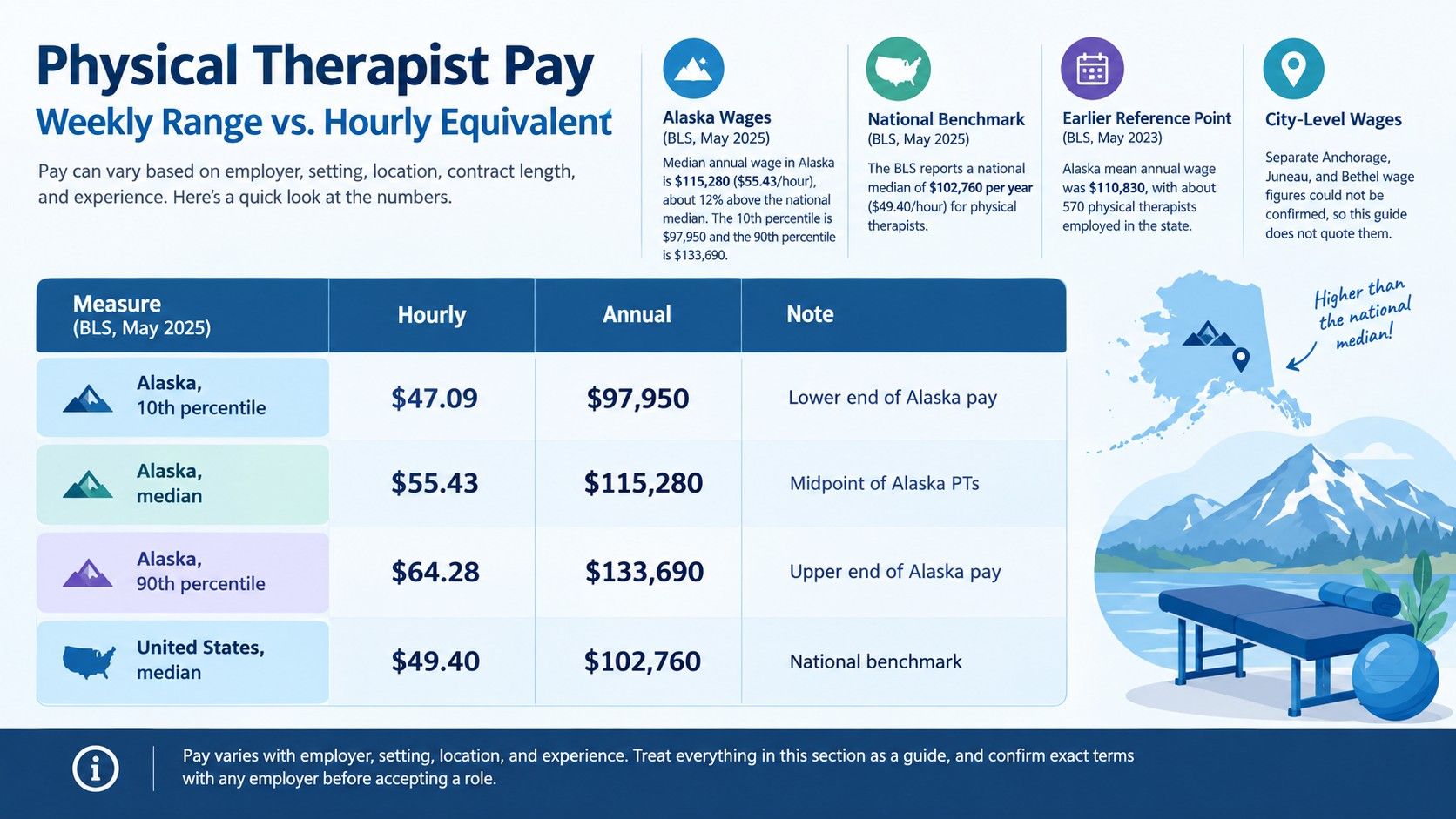
Pay varies with employer, setting, location, and experience. Treat everything in this section as a guide, and confirm exact terms with any employer before accepting a role.
• Alaska wages (BLS, May 2025): The median annual wage for physical therapists in Alaska is 115,280(55.43 per hour), about 12% above the national median. The 10th percentile is $97,950 and the 90th percentile is $133,690.
• National benchmark: The BLS reports a national median of 102,760peryear(49.40 per hour) for physical therapists as of May 2025.
• Earlier reference point: BLS May 2023 data put the Alaska mean annual wage at $110,830, with about 570 physical therapists employed in the state.
• City-level wages: Separate Anchorage, Juneau, and Bethel wage figures for physical therapists could not be confirmed, so this guide does not quote them.
Travel and contract roles: Travel contracts can pay differently from staff positions, because they often include stipends and compensate for short-notice relocation and remote locations. Housing stipends are generally tied to maintaining a qualifying tax home. Compare offers on total package: rate, housing stipend or arranged housing, travel reimbursement, guaranteed hours, and contract length, not the headline number alone.
Living and Working in Alaska: Practical Considerations
• Taxes: Alaska has no state income tax and no state sales tax. Some communities levy local sales tax, so check the community you are moving to.
• Cost of living: Costs, especially groceries and fuel in remote communities, run high. Plan your housing and budget with your recruiter early.
• Housing: Housing stipends are described as tax-free when a qualifying tax home is maintained. Remote assignments may include arranged housing.
• Weather and daylight: Winter darkness and summer daylight both affect routines. Many clinicians plan activities and sleep accordingly.
• Access and downtime: In fly-in and ferry-served communities, weather can delay travel. Build a cushion into travel days.
For a deeper look at housing, tax home, and remote-assignment realities, read our guide to travel nursing in Alaska, which covers many of the same lifestyle questions for healthcare travelers.
Who Alaska Is a Good Fit For
• PTs with some clinical experience, since many Alaska roles involve a broad scope and more independence.
• Clinicians who value autonomy, a broad scope, and a distinctive assignment.
• Travelers who enjoy the outdoors and can manage distance from family and familiar services.
• PTs who can plan licensure early and keep their dates flexible.
How to Get Started
1. Confirm your licensure path: full Alaska license by endorsement, or PT Compact privilege if your home state is a member.
2. Mail the required fingerprint card if applying for a license.
3. Talk with a recruiter about current openings in Anchorage, Juneau, Bethel, and Fairbanks.
4. Compare total packages, including stipends, housing, and guaranteed hours.
5. Plan travel and supplies before your start date, especially for fly-in communities.
Ready to explore current openings? View our Alaska physical therapist jobs, learn about our therapy staffing services, or contact our team and we will walk you through licensing timelines and placement options.
Conclusion
Alaska offers physical therapists a rare combination of clinical breadth, scenery, and strong pay. Anchorage, Juneau, and Bethel each deliver a different version of that experience, and the best choice depends on how much remoteness and autonomy you want. Start licensure early, compare total packages, and confirm current requirements with the Alaska Board.Alaska offers physical therapists a rare combination of clinical breadth, scenery, and strong contract compensation. Anchorage, Juneau, and Bethel each deliver a different version of that experience, and the best choice depends on how much remoteness and autonomy you want. Start licensure early, compare total packages, and talk with a recruiter who knows each community.
References & Sources
1. Alaska Division of Corporations, Business and Professional Licensing, Physical Therapy and Occupational Therapy (fingerprint requirement and compact notice): https://www.commerce.alaska.gov/web/cbpl/ProfessionalLicensing/PhysicalTherapyOccupationalTherapy.aspx
2. Alaska Statutes, Title 8, Chapter 84 (AS 08.84.060, 08.84.065, 08.84.100, 08.84.130): https://www.commerce.alaska.gov/web/Portals/5/pub/PT-OTStatutes.pdf
3. Physical Therapy Compact Commission, Member States: https://ptcompact.org/ptc-states
4. U.S. Bureau of Labor Statistics, Occupational Outlook Handbook, Physical Therapists: https://www.bls.gov/ooh/healthcare/physical-therapists.htm
5. O*NET OnLine, Physical Therapists (29-1123.00), Alaska wages (BLS 2025 data): https://www.onetonline.org/link/localwages/29-1123.00?st=AK
6. U.S. Bureau of Labor Statistics, OEWS May 2023, Alaska State Occupational Employment and Wage Estimates: https://www.bls.gov/oes/2023/may/oes_ak.htm
7. Alaska Department of Labor and Workforce Development, Alaska Statewide Wages 2025: https://live.laborstats.alaska.gov/wage/index.html
Questions
Frequently asked
Looking for your next assignment?
Browse current travel contracts, or tell a recruiter what you are after and we will match you against roles before they are listed.