
Hawaii Registered Nurse License by Endorsement | 2026 Guide

We Care Staffing
Hawaii Registered Nurse License by Endorsement
THE SHORT ANSWER
Hawaii is not a compact state, so you need a Hawaii license. The combined fee is $236.00 for the year ending 30 June 2027. The temporary permit needs a job offer first, and lasts up to one year. The board publishes no processing time.
Hawaii does not take part in the Nurse Licensure Compact, so a multistate license earned anywhere else will not let you practice in the islands. Every registered nurse moving to Hawaii needs a Hawaii license of her own, issued by the Hawaii Board of Nursing, and that process is worth understanding before you start looking at contracts.
This guide covers what the board asks for, what it costs in the current fee year, and the condition worth understanding before you start: the temporary permit requires a job offer before you can apply for it.
Is Hawaii a compact nursing state?
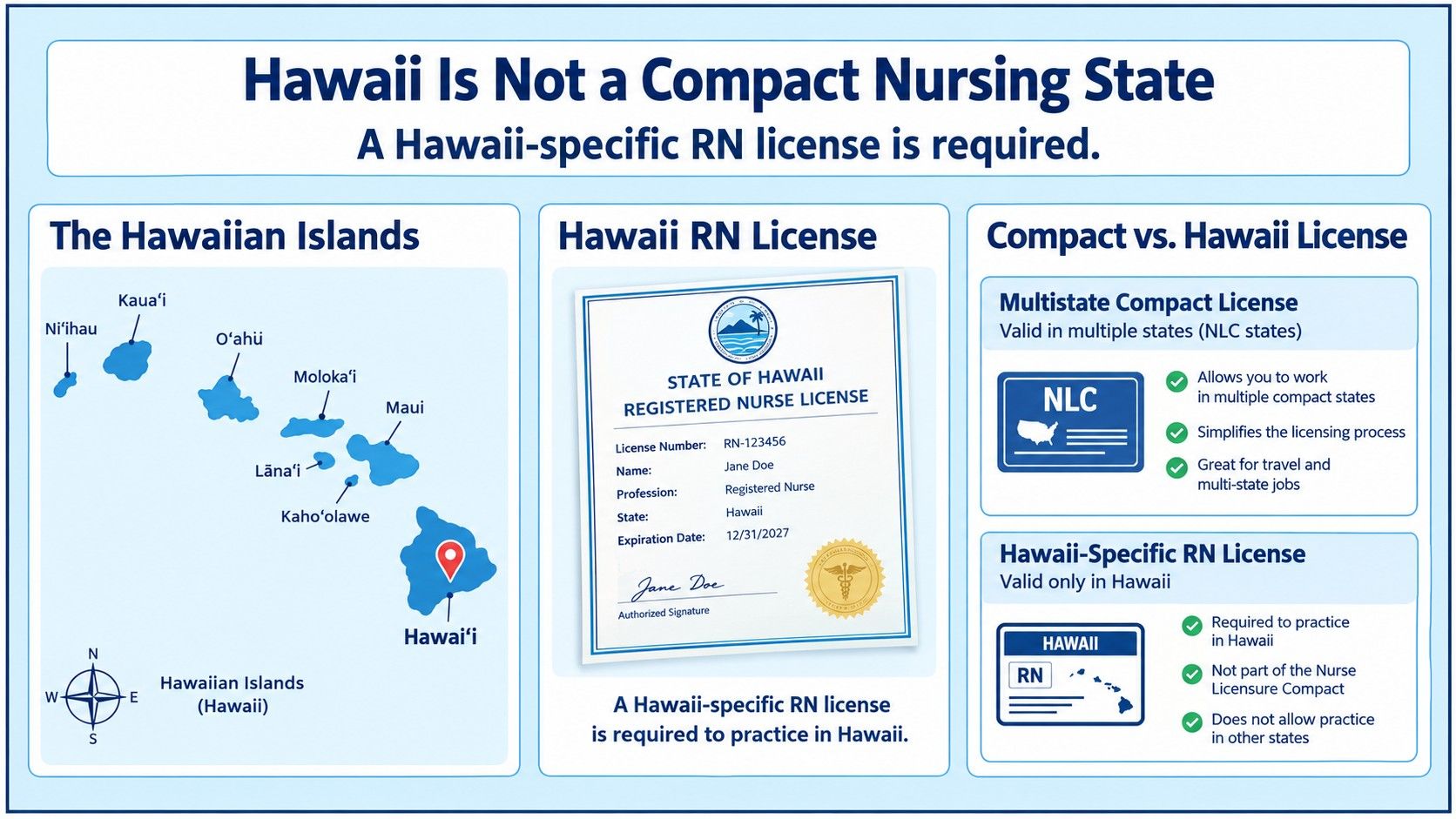
No. Hawaii is not a member of the Nurse Licensure Compact, and it has not enacted the legislation to join. A multistate license issued by any of the compact jurisdictions carries no authority to practice in Hawaii.
That is true no matter how many other states your multistate license covers. If you hold a compact license and you are used to crossing state lines without paperwork, Hawaii is the point where that stops. You will apply by endorsement, the same as a nurse holding a single-state license.
The practical effect is that every nurse arriving in Hawaii has cleared a licensing step a compact state would not have required, which is why Hawaii employers tend to plan further ahead than their mainland equivalents.
If you are comparing licensing requirements across states, read our guide to the California RN license by endorsement for another example of licensing in a noncompact state.
Who qualifies for a Hawaii RN license by endorsement
The Hawaii Board of Nursing sets six conditions for licensure by endorsement, and you need to meet all of them. They are:
- You are at least 18 years old.
- You are a United States citizen, a United States national, or an alien authorized to work in the United States.
- You hold a United States Social Security number.
- You are currently licensed as an RN in another state, territory or foreign country, and every license you hold is unencumbered.
- You graduated from an approved nursing program.
- You have already passed the NCLEX-RN, or the Canadian SBTPE, or a state board examination taken before that jurisdiction adopted the SBTPE.
The word unencumbered in condition four does a lot of work. It means no restriction, probation or pending action on any license you hold, not just the one you are endorsing from. If there is anything on your record in any state, declare it with the supporting documents rather than hoping it is not noticed, because the board checks every license you have ever held.
What a Hawaii RN license costs in 2026
Hawaii charges a single nonrefundable fee that covers both the temporary permit and the license by endorsement, and the amount depends on the fee year in which your permit is issued.
For a temporary permit issued between 1 July 2026 and 30 June 2027, the fee is $236.00. For one issued in the previous year, between 1 July 2025 and 30 June 2026, it was $304.00. The fee is set under Hawaii Administrative Rules 16-53-27(5) and it changes on 1 July, so check the current form before you send payment.
The application form itemises the components as follows: application $40, license $36, Center for Nursing $60, criminal record fee $50 or $100, half renewal $18, service charge $25, and temporary permit $50. Not every item applies to every applicant.
Budget separately for fingerprinting and for the National Practitioner Data Bank self-query, which are paid to those providers rather than to the board.
The temporary permit, and why you need a job offer first
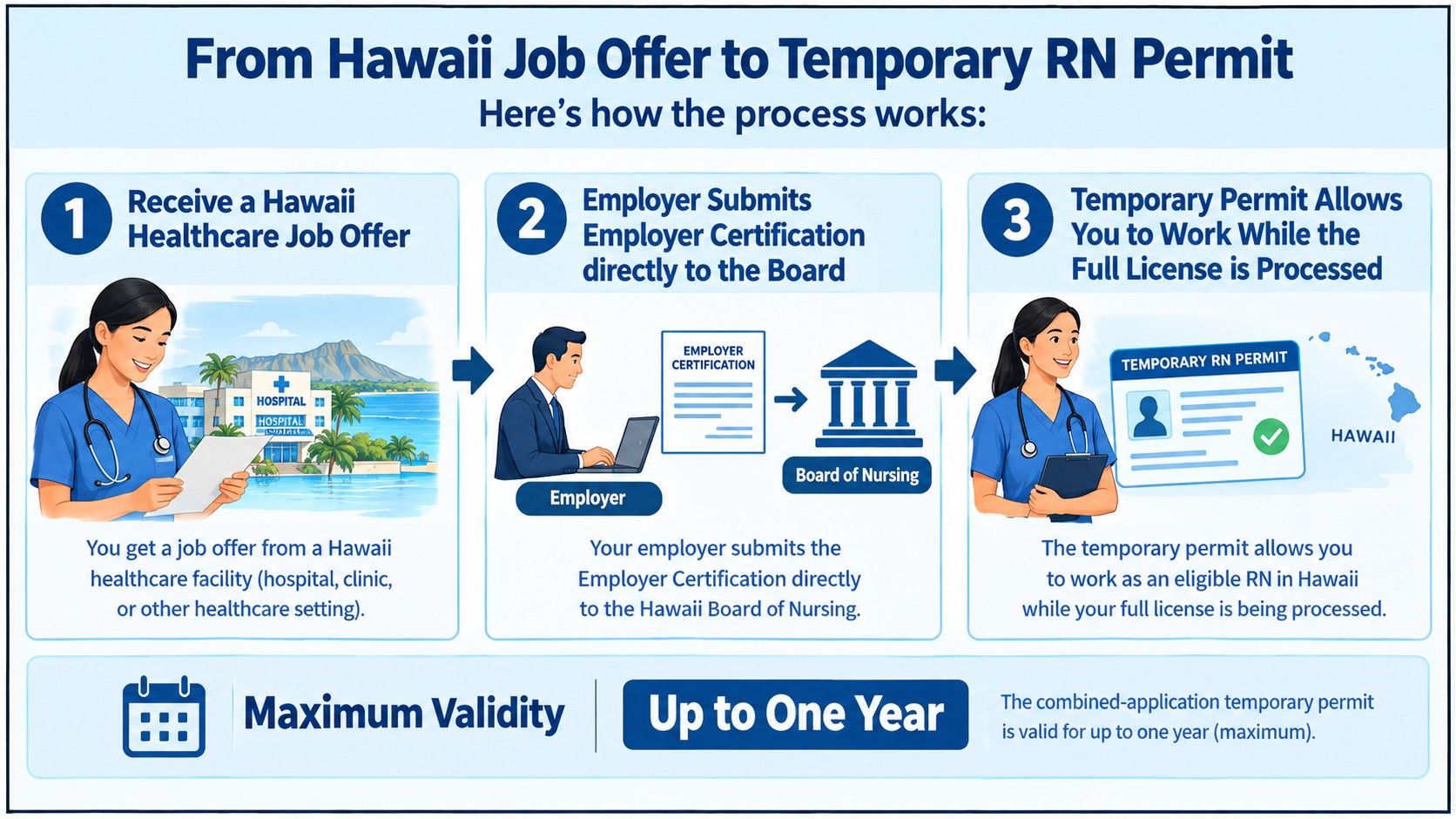
Hawaii will issue a temporary permit that lets you work while your full license is processed, but only if a Hawaii health care employer has already appointed or accepted you for employment. This works differently from Alaska, where the temporary permit is issued with no employer involvement at all, so a nurse licensing in both states will find the order reversed.
The employer has to send the Employer Certification to the board directly, by mail or email. A certification you forward yourself will not be accepted, and signatures have to be handwritten or digital rather than typed.
The permit is tied to that single employer. If you change employer you need a new permit, and your employer is required to tell the board when your employment ends. The permit stays valid until your full license is issued, up to a maximum of one year.
There is a standalone temporary permit you can apply for separately, without the combined application, and that one is valid for up to six months.
What this means in practice: line up the Hawaii job before you start the licensing paperwork, not after. The two run together, and the employer is part of the application.
If you are considering travel assignments in other states, explore our travel nursing opportunities and learn how We Care Staffing supports nurses through the assignment process.
The documents Hawaii will reject
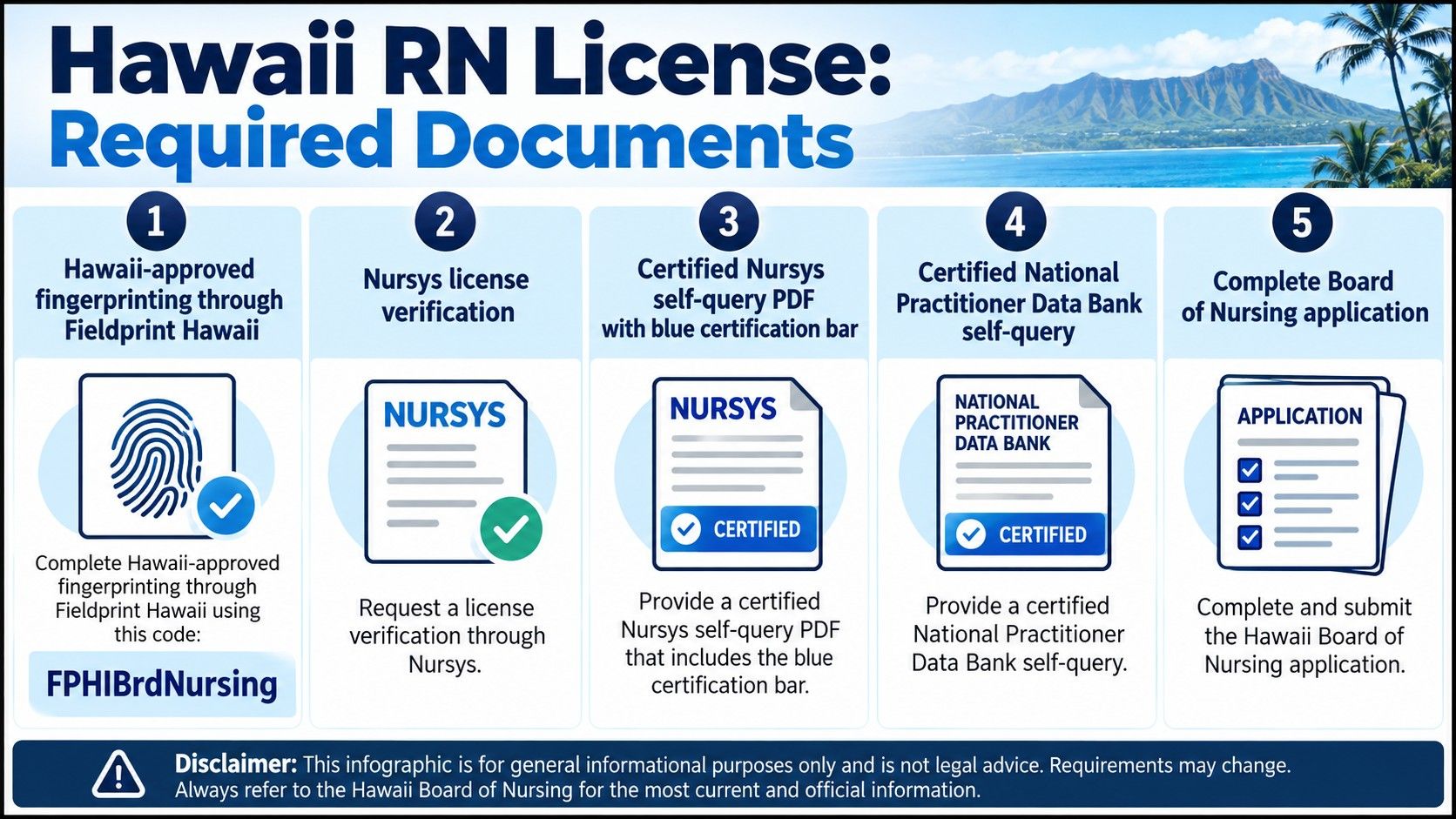
More endorsement applications are delayed by the wrong version of a document than by anything substantive, and Hawaii is specific about what it will not take.
Fingerprints have to go through fieldprinthawaii.com using the code FPHIBrdNursing. No other fingerprinting method is accepted, including cards you may already have on file from another state.
License verification has to come through Nursys, and the QuickConfirm report is not accepted. If your originating state does not use Nursys, verification has to come from that state directly.
A Nursys self-query PDF has to show the blue certification bar. Screenshots and links will be rejected.
The National Practitioner Data Bank self-query must be the certified report, either the digital version or the original sealed hard copy.
The board does not accept applications by email. An incomplete application gets a deficiency notice by email, and your application stays valid for one year from the date the board receives it.
How long a Hawaii RN license takes
The Hawaii Board of Nursing does not publish a processing time, and any guide quoting you a precise number is estimating rather than citing. What we can tell you is what actually governs the wait.
Three things sit outside the board’s control and outside yours: how quickly your fingerprints clear, how quickly the National Practitioner Data Bank returns your self-query, and how quickly each state you have ever been licensed in responds to a verification request. A nurse licensed in one state clears faster than a nurse licensed in four.
The step you do control is submitting a complete application the first time. A deficiency notice restarts the waiting, which is why the document rules in the section above are worth reading closely before you send anything.
If you want a realistic date for a specific start, ask whoever is handling your placement to tell you what they are currently seeing, rather than relying on a published average.
RN jobs in Hawaii
Because every nurse coming to Hawaii has to clear this licensing step, employers there plan further ahead than they would in a compact state, and a nurse who has already started her application is a considerably stronger candidate than one who has not.
If you are weighing up a Hawaii contract, it is worth having the conversation about timing early, so the licensing and the start date can be lined up rather than one waiting on the other.
Planning to work as a registered nurse in Hawaii? The We Care Staffing team can help you explore available assignments and understand the licensing steps before your start date. Contact our recruitment team to discuss your next opportunity.
References and Sources
1. NCSBN – Nurse Licensure Guidance
Visit NCSBN official licensing guidance
Use for general licensing guidance and compact-state information.
2. NCSBN – Compact vs. Noncompact Licensing
Confirms that nurses must apply for licensure by endorsement in a noncompact state.
3. Hawaii Professional and Vocational Licensing
Use for state-specific application rules, fees and temporary permits.
Questions
Frequently asked
Looking for your next assignment?
Browse current travel contracts, or tell a recruiter what you are after and we will match you against roles before they are listed.