

Travel Nursing in Hawaii: Pay, Housing & What to Know Before You Go
For a lot of nurses, a Hawaii assignment is the dream: trade a mainland winter for beaches, volcanoes, and the aloha spirit while still doing the work you love. Hawaii can absolutely be one of the most rewarding assignments of your career. But it is also one of the most misunderstood, because the pay is not what most people assume, the cost of living is the highest in the country, and the licensing rules trip up nurses who wait too long.

We Care Staffing

This honest, in-depth guide covers what actually matters about travel nursing in Hawaii in 2026: what you'll really earn, how housing and cost of living work, how to get licensed, and the practical realities of island assignments. If you're weighing a contract, you can also explore current Hawaii RN openings with We Care Staffing as you read.
Is Travel Nursing in Hawaii Worth It? The Honest Answer
Yes, but for the right reasons. If you're chasing the highest possible paycheck, Hawaii is not it, and any guide that tells you otherwise is selling something. Hawaii pay lands near the national average, well below high-premium states. What Hawaii offers instead is lifestyle: a genuinely different pace, extraordinary natural beauty, and diverse patient populations you won't encounter anywhere else. Nurses who go for the experience, and who do the cost-of-living math honestly before signing, tend to love it. Nurses who go expecting California-style pay are usually disappointed.
Travel Nurse Pay in Hawaii (2026)
How Hawaii travel pay is structured
Like all travel contracts, Hawaii pay combines a taxable hourly base wage with tax-free stipends for housing and meals. The number that matters is your blended rate, meaning total weekly compensation divided by hours worked. Understanding that structure is essential before you compare any two offers. If you're new to how travel packages work, our travel nursing program overview walks through the basics.
What you can realistically earn
Across major job boards in 2026, the average travel nurse weekly pay in Hawaii sits at roughly $2,100 to $2,400 per week, with typical ranges from about $1,600 to $2,800, and high-demand specialties or hard-to-staff neighbor-island contracts reaching higher. Blended rates commonly land near $58 an hour. Most Hawaii contracts run about 13 weeks.
For comparison, a strong California travel contract frequently pays well above that. The takeaway is not that Hawaii pays badly, since it's roughly on par with the national average, but that it does not carry the premium of the highest-paying mainland markets. You are effectively trading some income for the experience.
Which specialties and locations pay more
High-acuity specialties (ICU, ER, PCU, and OR) and neighbor-island facilities that are harder to staff, particularly on the Big Island, often pay a bit more than general med-surg roles in Honolulu. If maximizing pay within Hawaii is your goal, being open to the neighbor islands and to high-demand units is the most reliable lever.
The Cost of Living Reality
Here's the part that decides whether a Hawaii contract works financially. Hawaii has the highest cost of living of any U.S. state, and it isn't close. Because nearly everything is shipped in, groceries, gas, dining, and especially housing all cost significantly more than on the mainland. A weekly package that looks fine on paper can feel tight once you're paying island prices. This is exactly why the honest approach is to calculate your expected rent and living costs first, then judge the contract on what's left over, not on the gross number.
Housing for Travel Nurses in Hawaii

Housing is the single biggest logistical challenge of a Hawaii assignment. Inventory is limited, prices are high, and demand from other travelers and tourists is constant. You generally have two options: take agency-provided housing, where the agency arranges and pays for a place, or take the tax-free housing stipend and secure your own. Many travelers take the stipend, but in Hawaii that means starting your search early, because good, affordable short-term rentals go fast.
A few Hawaii-specific realities to plan around: inter-island logistics matter, so the island you match with affects your flights and daily life; shipping a car is expensive, so many travelers rent or use local transit instead; and furnished, flexible-lease rentals are worth their weight in gold. Remember that tax-free stipends are only tax-free if you maintain a legitimate tax home and the assignment is temporary under IRS rules, and the amounts are capped by federal GSA per diem rates for the island county.
Getting Licensed: Hawaii Is Not a Compact State
This is where nurses lose start dates, so plan for it early. Hawaii is not part of the Nurse Licensure Compact, which means a multistate compact license does not let you work there. Every travel nurse needs a Hawaii-specific RN license issued by the Hawaii Board of Nursing, administered through the state's Department of Commerce and Consumer Affairs (DCCA) Professional and Vocational Licensing division.
Key things to know about the Hawaii license:
- Licensure by endorsement is the path if you already hold an active RN license in another state.
- Fees are relatively modest, generally in the range of about $166 to $234.
- Hawaii is not a "walk-through" state. Unlike some states that issue a quick temporary permit, Hawaii generally requires your full license to be issued before you can work, so you cannot count on starting while it processes.
- Processing takes several weeks or longer, so apply as early as possible, ideally two to three months before your target start date.
- Continuing education: Hawaii requires 30 hours of continuing competency every two years, with its own rules about how those hours are earned.
- Renewal falls on June 30 of every odd-numbered year.
Because the timeline is the biggest risk, start the application the moment you're serious about Hawaii. A good agency's licensing team can help you sequence transcripts, verification, and fingerprinting so nothing stalls; if you want help, reach out to our team early in your planning.
Where the Jobs Are: Hawaii's Islands and Hospitals
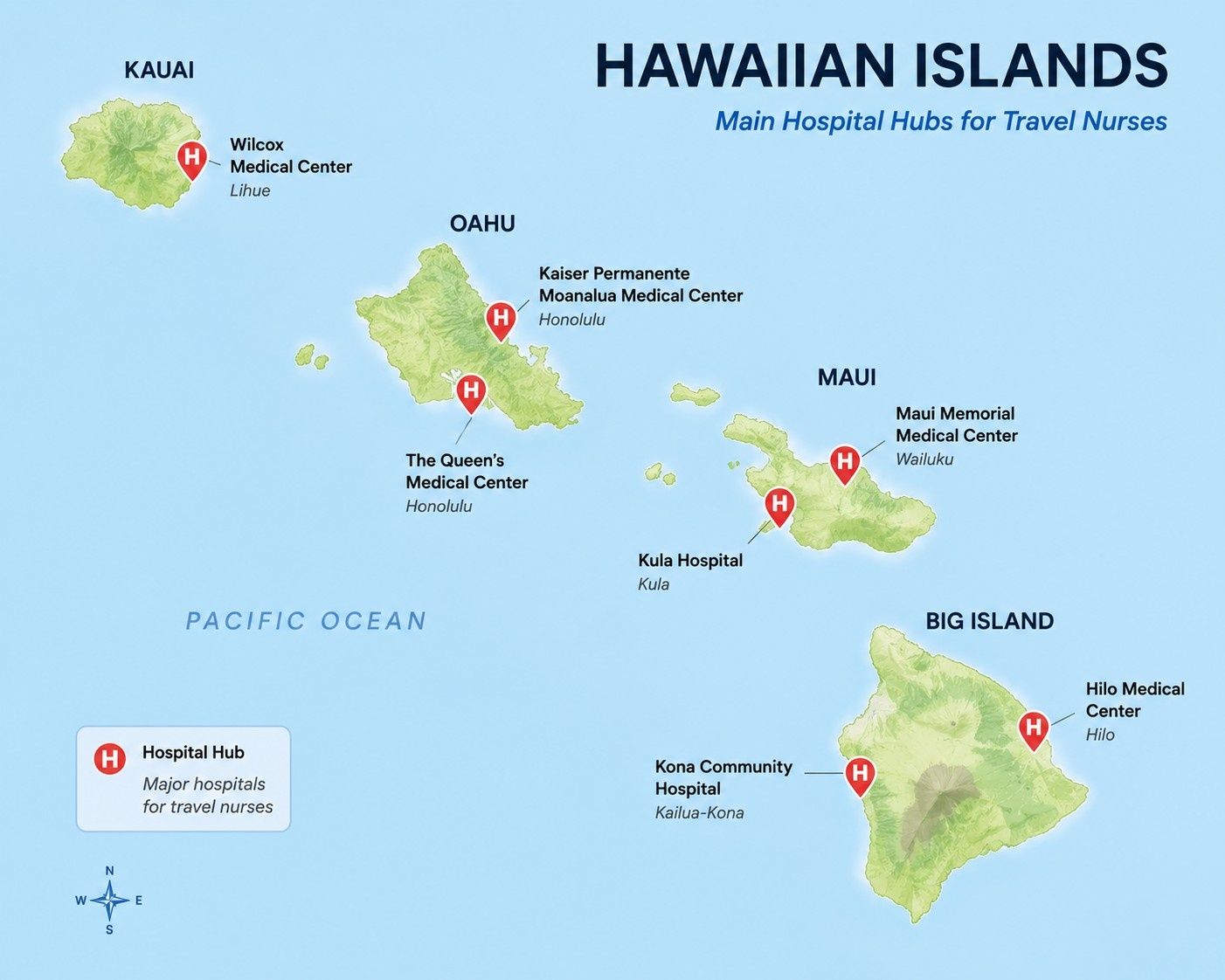
Most travel assignments are concentrated on Oahu, home to Honolulu and the state's largest facilities, including The Queen's Medical Center, Kaiser Permanente, Straub, and Kapiolani. The Big Island offers steady contract volume at facilities such as Hilo Medical Center and Kona Community Hospital, and often pays competitively because some roles are harder to fill. Maui (Maui Memorial Medical Center) and Kauai round out the market. Oahu has the most jobs and the most amenities; the neighbor islands offer a quieter experience and sometimes stronger relative pay. Both approaches are valid, and it comes down to the lifestyle you want.
What to Know Before You Go
Beyond pay, housing, and licensing, a few realities make or break a Hawaii assignment:
- Respect the culture. Hawaii has a deep, living Native Hawaiian culture and a complicated history with mainland transplants. Go as a humble guest, learn a little about local customs and the meaning of aloha and kuleana, and you'll be welcomed. Cultural humility matters at the bedside too, given Hawaii's uniquely diverse patient populations.
- Budget for logistics. Flights to and between islands, shipping belongings, and higher day-to-day prices all add up. Factor them into your real take-home.
- Understand the taxes. Hawaii has a progressive state income tax with a top rate around 11 percent, though most travelers fall in lower brackets, and only your taxable base wage is taxed, not qualified stipends.
- Manage expectations on pace. Island life is slower, in the best and occasionally the most frustrating ways. Patience is part of the package.
How to Make the Most of a Hawaii Travel Contract
- Do the cost-adjusted math first. Estimate rent and living costs, then judge the contract on what's left.
- Start licensing immediately. The Hawaii license timeline is the most common reason nurses miss start dates.
- Search housing early and stay flexible. Furnished, short-term, flexible-lease rentals are the goal.
- Consider the neighbor islands. They can offer better relative pay and a quieter experience.
- Protect your tax home. Keep documentation so your stipends stay tax-free.
- Go for the right reasons. Choose Hawaii for the experience, with pay as a fair, not premium, trade.
If a quieter, lifestyle-driven assignment appeals to you, another remote, high-nature option worth comparing is travel nursing in Alaska, which offers a very different flavor of the same adventure.
Conclusion
Travel nursing in Hawaii is one of the most rewarding experiences in the profession, as long as you go in clear-eyed. The pay is fair rather than premium, the cost of living is the highest in the nation, housing takes real planning, and the license must be secured well in advance. Handle those four things thoughtfully, and Hawaii delivers something no paycheck can: a chapter of your career spent living and working in one of the most beautiful places on earth. When you're ready, browse current Hawaii travel nurse assignments and start your license early so you're ready when the right contract appears.
References & Sources
All data points are drawn from the following publicly available sources (accessed June 2026). The Hawaii Board of Nursing, IRS/GSA, and BLS are the authoritative baselines; agency and job-board pay figures vary by methodology.
- Hawaii Board of Nursing (DCCA Professional & Vocational Licensing) — licensure by endorsement, fees, CE, renewal: https://cca.hawaii.gov/pvl/boards/nursing/
- U.S. General Services Administration — Per Diem Rates (housing/meal stipend caps by county): https://www.gsa.gov/travel/plan-book/per-diem-rates
- IRS — Tax Home and Travel Expense Rules (Publication 463): https://www.irs.gov/publications/p463
- U.S. Bureau of Labor Statistics — Registered Nurses (baseline RN wage and outlook data): https://www.bls.gov/ooh/healthcare/registered-nurses.htm
- Nurse Licensure Compact (NLC) — participating states (confirming Hawaii is not a member): https://www.nursecompact.com
Questions
Frequently asked
Looking for your next assignment?
Browse current travel contracts, or tell a recruiter what you are after and we will match you against roles before they are listed.