
Physical Therapist vs. Physiotherapist Jobs in California: Titles, Licensing & Pay
Quick Answer In California, a physiotherapist and a physical therapist are the same licensed profession. The state restricts both titles to people holding a California physical therapist license, so you cannot practice or advertise as either one without it. If you were trained abroad as a physiotherapist, you can work here, but only after completing the Physical Therapy Board of California (PTBC) foreign-educated pathway, which includes the NPTE, the California law exam, and a supervised clinical service period. Pay for licensed PTs in California is among the highest in the country.

We Care Staffing

Physical Therapist vs. Physiotherapist: Is There a Difference?
No, not in terms of the job. The two words describe the same discipline: examining patients, diagnosing movement problems, and treating them with exercise, manual therapy, and education. The difference is geography. Physiotherapist (and the casual "physio") is the standard title in the United Kingdom, Canada, Australia, and much of the world. Physical therapist, or PT, is the standard title in the United States, and U.S. billing and legal language is built around it.
For job seekers, that matters in two practical ways. First, employers and job boards in California overwhelmingly post openings as "physical therapist" or "PT," so searching only for "physiotherapist" will miss most listings. Second, California law treats the titles as protected, which is covered below.
Who Can Legally Use Each Title in California
California Business and Professions Code section 2633 limits these designations to licensed physical therapists: "physical therapist," "P.T.," "licensed or registered physiotherapist," "L.P.T.," and "R.P.T." Section 2630 makes it unlawful to practice or offer to practice physical therapy for compensation, or to present yourself as a physical therapist, without a valid license. The PTBC publishes these rules on its unlicensed practice page.
The practical takeaway for hiring managers and job seekers: a foreign-trained physiotherapist who has not yet been licensed by the PTBC should not use either title in a California resume headline, LinkedIn profile, or job application for a clinical role. Describe your credential accurately (for example, "physiotherapist trained in [country], California licensure in progress") and let the licensure status be clear.
How to Get Licensed as a Physical Therapist in California
Path 1: U.S.-educated, licensed in another state (endorsement)
This is the route most travel and out-of-state therapists use. The PTBC lists the steps for U.S.-educated endorsement applicants:
- Register for and complete the CAL-JAM, California's law exam, through the Federation of State Boards of Physical Therapy (FSBPT). It has 50 questions, a one-hour time limit, costs $50 (paid to the Federation), and can be taken online, even from outside California. You have 96 hours from your authorization to test to complete it.
- Submit the online application to the PTBC through the BreEZe system, along with the required documents and fees.
- The PTBC acknowledges receipt within 30 days of receiving your application and fee.
- The Board reviews your file and emails you, and posts updates in your BreEZe account. Your CAL-JAM score is transferred to the Board electronically.
- Resolve any deficiencies. The PTBC states it issues the license within 45 days of the last deficiency being fulfilled.
Fees: The PTBC fee page for initial licensure lists a $300 nonrefundable application processing fee, a $150 initial license fee, and a $49 fingerprint fee that applies only if you submit a fingerprint card (Live Scan fees are paid at the Live Scan site instead). Confirm the current fee schedule for endorsement applicants on the PTBC site before publishing this figure.
No temporary permit for travel assignments. According to We Care Staffing's California PT page, California requires a full California PT license, is not part of the Physical Therapy Compact, and does not offer a temporary permit for contract work. Plan your licensure timeline before you accept a start date, because staffing agencies can help with paperwork but cannot shorten the Board's timeline.
Path 2: Foreign-educated physiotherapists and physical therapists
If you trained outside the United States, you are on the foreign-educated pathway. Based on the PTBC clinical service page:
- You must pass both the NPTE (National Physical Therapy Examination) and the CAL-JAM.
- After passing the exams, you must complete a nine-month clinical service period (Business and Professions Code section 2653). You cannot begin until the PTBC authorizes it in writing.
- The facility, the Center Coordinator of Clinical Education, and the clinical instructors need written PTBC approval. The coordinator and instructors must be APTA-certified, and a supervising physical therapist must be onsite and available.
- Your performance is evaluated midway and at the end, using the APTA Clinical Performance Instrument or the Federation's Performance Evaluation Tool. The PTBC allows 30 days to review the application and 30 days to review the final evaluations.
- The PTBC does not help you find a clinical site or instructors. Finding one is your responsibility.
- If you are already licensed and working full time in another U.S. jurisdiction, you can request a waiver. Clinical service is reduced by one month for each month you worked as a licensee outside California, up to the full nine months.
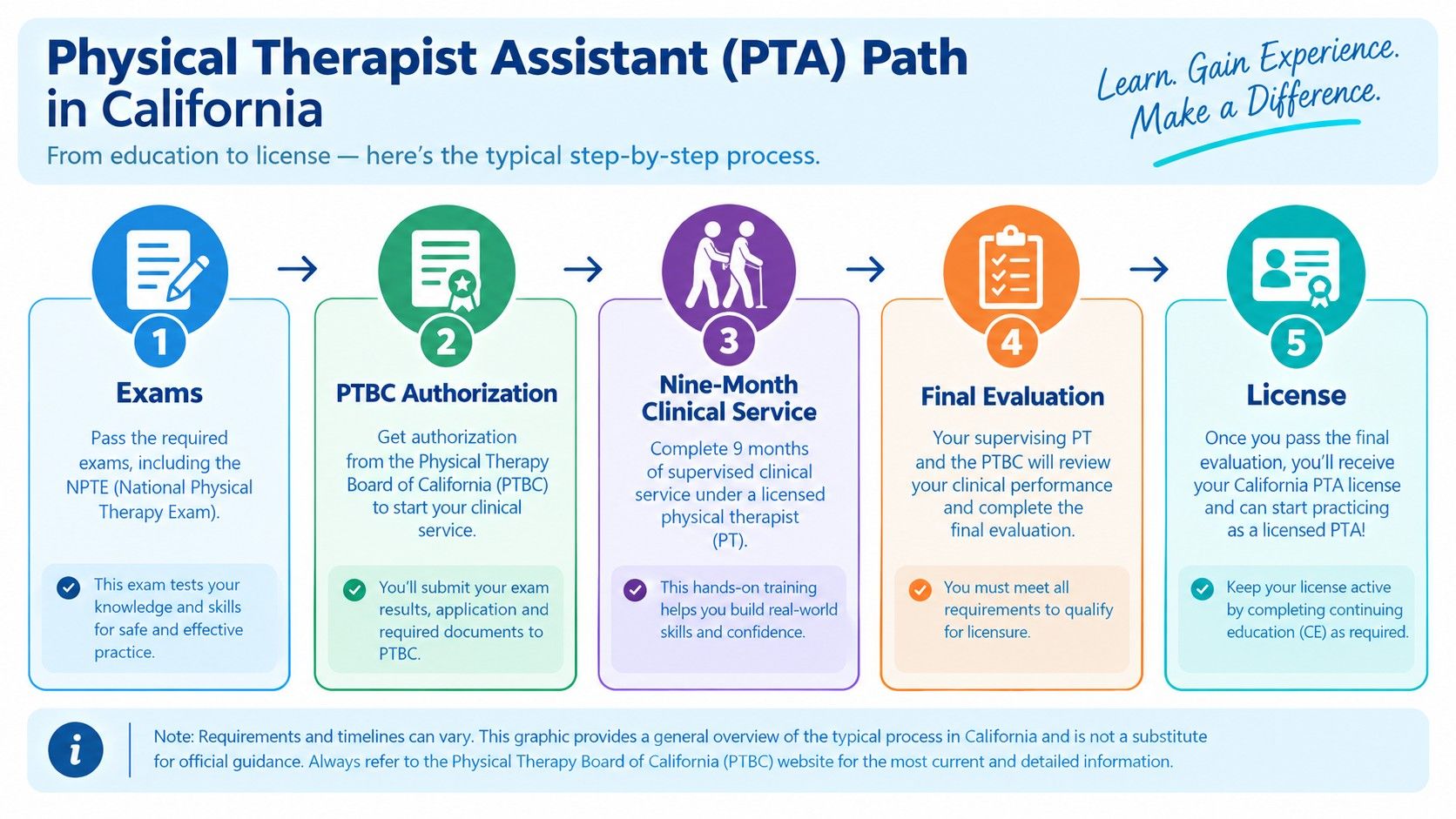
Education credential review and other foreign-educated requirements have additional steps beyond what is summarized here. Foreign-trained applicants should read the PTBC foreign-educated applicant pages in full before starting, because requirements and forms change.
Physical therapist assistants
Physical therapist assistants (PTAs) are licensed separately, work under PT supervision, and cannot use PT or physiotherapist titles. If you see a job listing for a "physical therapy assistant," it is a different role with different pay and scope.
How Much Do Physical Therapists Earn in California?
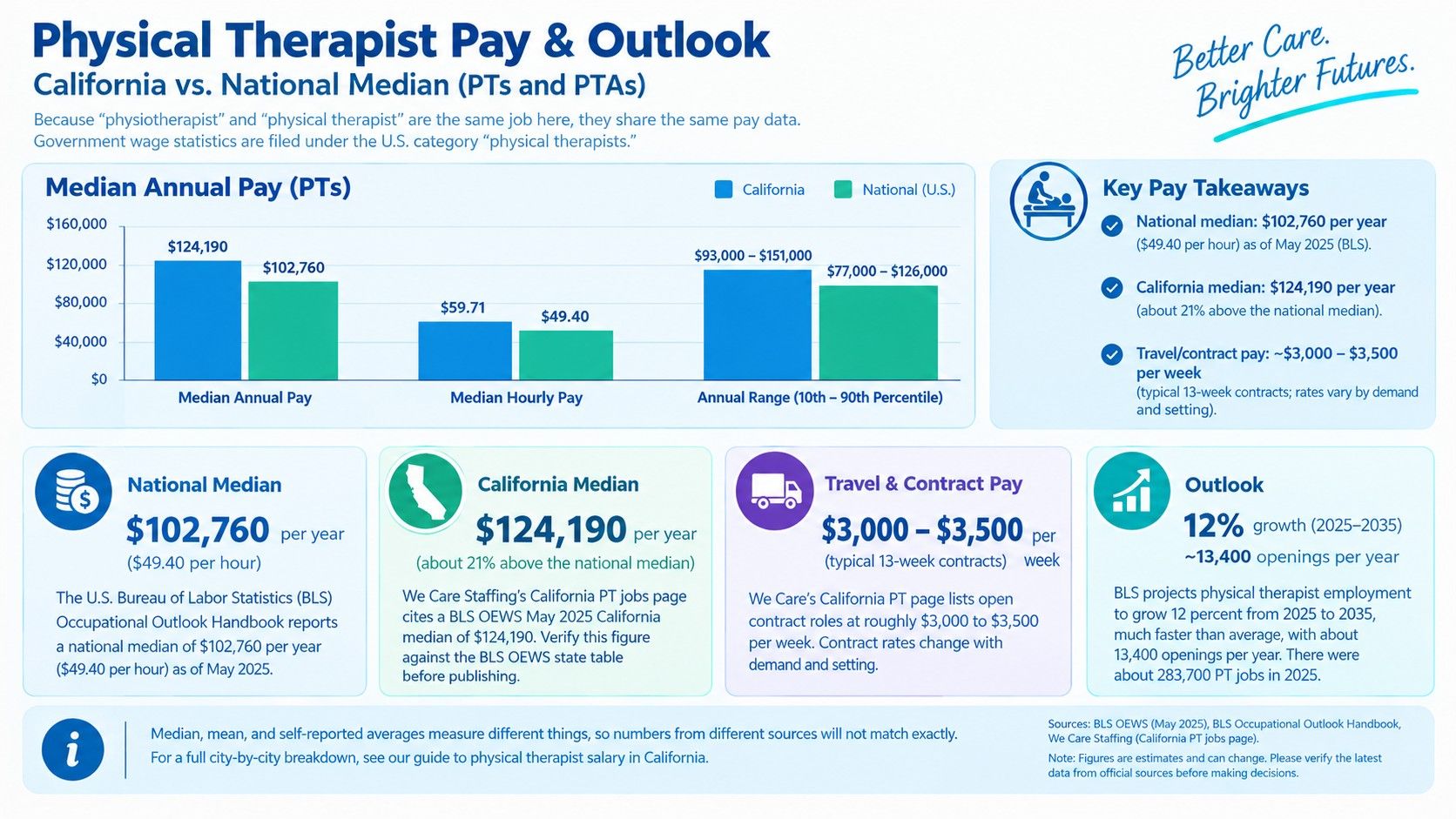
Because "physiotherapist" and "physical therapist" are the same job here, they share the same pay data. Government wage statistics are filed under the U.S. category "physical therapists."
- National median: The U.S. Bureau of Labor Statistics (BLS) Occupational Outlook Handbook reports a national median of $102,760 per year ($49.40 per hour) as of May 2025.
- California median: We Care Staffing's California PT jobs page cites a BLS OEWS May 2025 California median of $124,190, which is about 21% above the national median. Verify this figure against the BLS OEWS state table before publishing.
- Travel and contract pay: We Care's California PT page lists open contract roles at roughly $3,000 to $3,500 per week, with typical contracts of 13 weeks. Contract rates change with demand and setting.
- Outlook: BLS projects physical therapist employment to grow 12 percent from 2025 to 2035, much faster than average, with about 13,400 openings per year. There were about 283,700 PT jobs in 2025.
Median, mean, and self-reported averages measure different things, so numbers from different sources will not match exactly. For a full city-by-city breakdown, see our guide to physical therapist salary in California.
How to Search for Physical Therapist Jobs in California
- Search both terms, but lead with "physical therapist" and "PT." Most California employers use the U.S. title.
- Know the setting keywords: outpatient orthopedic, home health, acute care, skilled nursing, and school-based roles all appear under the same PT title.
- Choose your employment type: permanent, per diem, or contract. Contract roles typically run 13 weeks.
- Start licensure early. Because there is no temporary permit, the license timeline, not the job search, is usually the bottleneck.
- Ask about licensure support. A staffing partner can help with paperwork and placement but cannot speed up Board review.
Browse current openings on our California physical therapist jobs page, learn about our therapy staffing services, or contact our team to talk through your licensure timeline and placement options.
Common Mistakes to Avoid
- Using "physiotherapist" or "PT" on a California resume or profile before holding a PTBC license.
- Assuming a compact privilege or temporary permit will let you start a California contract right away.
- Starting the foreign-educated clinical service period before receiving written PTBC authorization.
- Confusing a PTA (assistant) listing with a PT listing.
- Comparing salary numbers from different sources as if they were measuring the same thing.
Conclusion
Physical therapist and physiotherapist are two names for one profession, but California only recognizes one pathway to using either title: a PTBC license. If you are licensed in another state, endorsement is the route. If you trained abroad, plan for the NPTE, the CAL-JAM, and nine months of supervised clinical service unless you qualify for a reduction. Once licensed, you enter one of the best-paid PT markets in the country.
References & Sources
- Physical Therapy Board of California, Unlicensed Practice (Business and Professions Code sections 2630, 2633, 2633.5): https://www.ptbc.ca.gov/consumers/unlicensed_practice.shtml
- Physical Therapy Board of California, US-Educated Endorsement Process: https://www.ptbc.ca.gov/applicants/endorsement/process.shtml
- Physical Therapy Board of California, Endorsement Exam Information (CAL-JAM): https://ptbc.ca.gov/applicants/endorsement/exam.shtml
- Physical Therapy Board of California, Fees: https://ptbc.ca.gov/applicants/new_grad/fees.shtml
- Physical Therapy Board of California, Foreign-Educated PT Clinical Service Period: https://www.ptbc.ca.gov/applicants/foreign_pt/clinical.shtml
- U.S. Bureau of Labor Statistics, Occupational Outlook Handbook, Physical Therapists: https://www.bls.gov/ooh/healthcare/physical-therapists.htm
- We Care Staffing, Physical Therapist Jobs in California: https://www.we-carestaffing.com/physical-therapist-jobs-in-california
- We Care Staffing, Physical Therapist Salary in California: https://www.we-carestaffing.com/blog/physical-therapist-salary-california
- Physitrack, Should American PTs Start Calling Themselves "Physios"? (title usage by country): https://www.physitrack.com/insights/physio-vs-physical-therapist-debate
Questions
Frequently asked
Looking for your next assignment?
Browse current travel contracts, or tell a recruiter what you are after and we will match you against roles before they are listed.