ICU vs NICU vs L&D Travel Nursing: Pay, Demand & Which Specialty Is Right for You
Three of the most in-demand travel nursing specialties, intensive care (ICU), neonatal intensive care (NICU), and labor and delivery (L&D), all pay well, all stay busy, and all ask something very different of you. Choosing between them isn't just about the highest weekly rate. It's about the kind of patients you want, the emotional weight you can carry, and the career you can sustain for years, not just one contract.

We Care Staffing
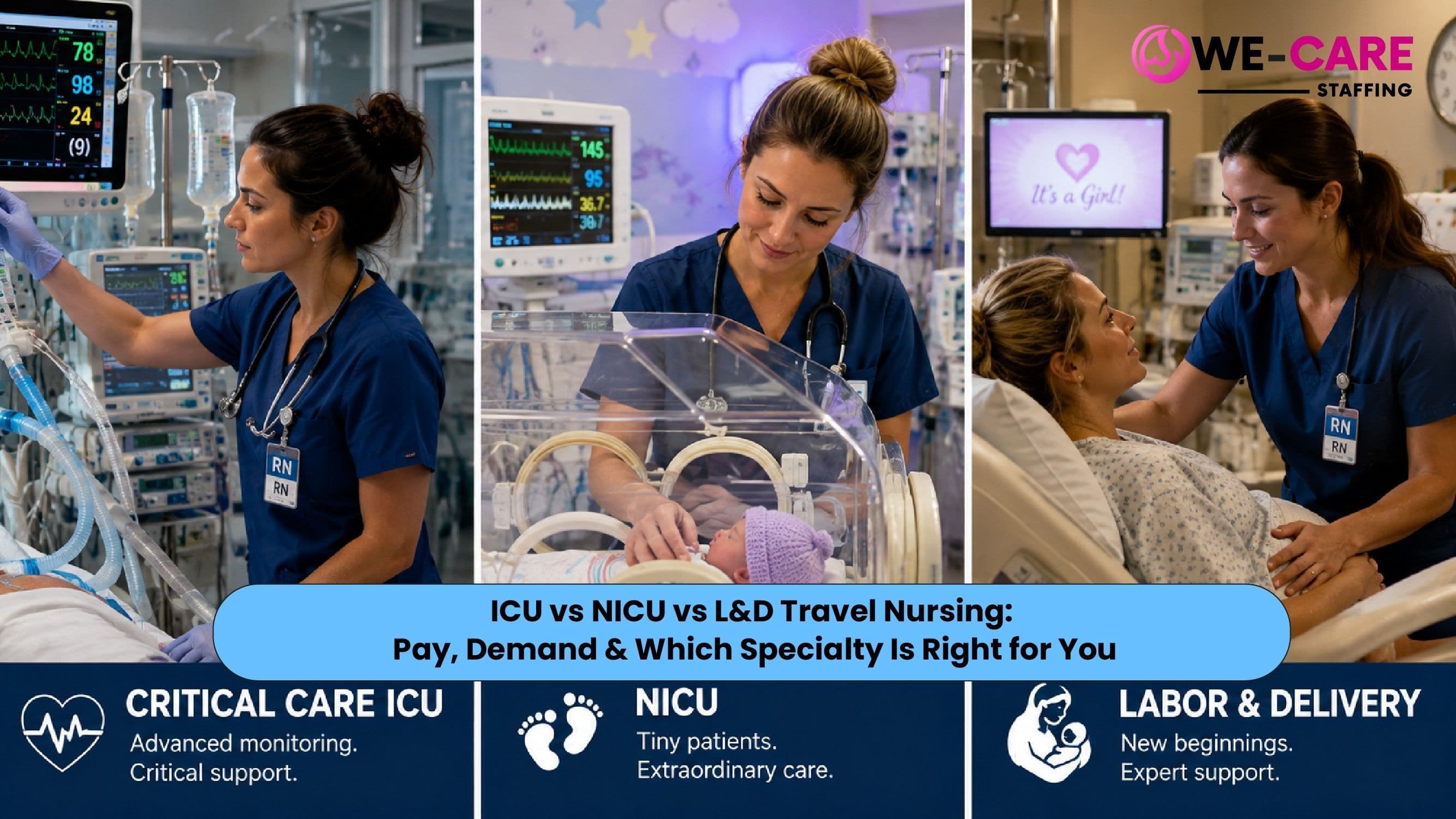
This guide compares ICU vs NICU vs L&D travel nursing on pay, demand, required credentials, and day-to-day reality, then helps you decide which fits. Everything is grounded in current travel-market data. If you're ready to explore assignments in any of the three, you can browse current travel nursing opportunities with We Care Staffing as you read.
Quick Comparison: ICU vs NICU vs L&D
Here's the landscape at a glance. Treat pay as ranges that vary by location, season, and acuity, not fixed figures.
The short version: ICU tends to pay the most and has the broadest demand, NICU is a specialized niche with a smaller candidate pool, and L&D offers steady demand with a very different emotional rhythm. Now the detail.
ICU Travel Nursing: Top Pay, Broadest Demand

Pay. ICU (intensive care) is consistently one of the highest-paying travel specialties, with weekly packages commonly in the $2,600 to $4,200 range, and crisis or high-demand contracts pushing higher. Sub-specialties like trauma ICU (SICU) and cardiac ICU can run at the top of that band.
Demand. Demand is very high and geographically broad. Ongoing critical-care shortages, an aging population, and the constant need for nurses who can manage ventilators, drips, and hemodynamic monitoring mean ICU contracts are almost always available somewhere.
Credentials. Facilities typically want at least one to two years of recent ICU experience, and the CCRN (Critical Care Registered Nurse) certification opens the strongest contracts. ACLS is expected.
The reality. ICU is high-acuity, high-stakes work with critically ill adults. It maximizes short-term earning potential, but it carries a genuine burnout risk over time. If you thrive on complexity, autonomy, and intensity, and can protect yourself from the emotional load, ICU is the pay leader of the three.
NICU Travel Nursing: A Specialized, High-Value Niche

Pay. NICU (neonatal intensive care) travel pay commonly runs in the $2,300 to $3,300-plus range, and because the specialty requires narrow, hard-to-replace skills, high-demand contracts and metros can push well above that. The limited candidate pool works in your favor on pay.
Demand. Demand is strong and steady, though the pool of qualified NICU travelers is smaller than ICU's. Level III and IV NICUs in particular need experienced travelers who can step in immediately, and facilities typically require a minimum of two years of recent, in-hospital NICU experience.
Credentials. The RNC-NIC (neonatal intensive care certification) is the credential that signals expertise and unlocks premium roles, alongside NRP (Neonatal Resuscitation Program).
The reality. NICU means caring for the tiniest, most fragile patients, premature and critically ill newborns, often over long stays, while supporting frightened families. It's detailed, emotionally intense, and deeply rewarding for nurses drawn to neonatal care. It's a niche, and that niche is exactly what gives you leverage.
L&D Travel Nursing: Steady Demand, a Different Rhythm

Pay. Labor and delivery (L&D) travel pay commonly lands in the $2,300 to $3,000-plus range, with high-demand contracts, including some of the highest-paying L&D roles reported well above $3,000 a week during busy periods, reaching higher. It sits a notch below ICU on typical pay but remains a strong, in-demand specialty.
Demand. Demand is steady and broad, since babies arrive regardless of the economy. L&D units need travelers who can manage both routine deliveries and rapidly escalating emergencies, and the mix of scheduled and unpredictable volume keeps contracts flowing.
Credentials. The RNC-OB (inpatient obstetric nursing certification) is the key credential, alongside fetal monitoring certification (such as AWHONN's) and NRP. Facilities generally want recent L&D experience.
The reality. L&D is unique among the three: mostly joyful, occasionally one of the highest-stakes environments in the hospital when a delivery goes wrong in seconds. You're caring for two patients at once, mother and baby, and the emotional range runs from celebration to crisis. For nurses who love maternal-child care and fast pivots, it's a rewarding, sustainable specialty.
How to Choose the Right Specialty
Pay matters, but the right specialty is the one you can do well and sustain. A few honest questions to guide you:
- Chasing the highest pay and broadest options? ICU leads on both, if you can manage the acuity and guard against burnout.
- Drawn to neonatal care and detail-oriented work? NICU rewards that passion with strong pay and a niche that protects your leverage.
- Love maternal-child nursing and a mix of joy and adrenaline? L&D offers steady demand and a genuinely different daily experience.
- Already certified? Your existing credential (CCRN, RNC-NIC, or RNC-OB) and recent experience largely determine which contracts you can access right now. The fastest path is usually to travel in the specialty you already know, then cross-train later if you want to switch.
- Thinking long-term? Consider sustainability, not just this contract's rate. The best specialty is one you can work for years without burning out.
If you're weighing options and want help matching your certifications and experience to specific assignments, reach out to our team and a recruiter can map it out with you.
A Few Truths That Apply to All Three
- Pay is a package, not a rate. Every figure here blends a taxable base wage with tax-free housing and meal stipends. Compare the blended rate (total weekly pay divided by hours), not the headline number.
- Location and season swing pay hard. High-cost, high-shortage states like California pay more, and busy seasons lift rates across all three specialties.
- Certifications are leverage. CCRN, RNC-NIC, and RNC-OB don't just look good; they unlock contracts less-credentialed nurses can't take.
- Experience is the entry ticket. All three typically require one to two-plus years of recent, in-hospital experience in the specialty.
- Rates have normalized. 2026 pay is healthy but below the 2021–2022 crisis peaks, so be realistic about listings promising pandemic-era numbers.
Conclusion
ICU, NICU, and L&D are three of the strongest travel nursing specialties, and there's no universal "best," only the best fit for you. ICU pays the most and offers the widest demand, NICU is a specialized niche where scarcity protects your value, and L&D pairs steady demand with a uniquely rewarding emotional rhythm. Choose based on the patients you're called to, the credential you hold, and the pace you can sustain, then let pay be the tiebreaker rather than the sole driver. When you're ready, explore current travel nursing assignments and let a recruiter help you find the right contract in your specialty.
References & Sources
All data points are drawn from the following publicly available sources (accessed June 2026). Travel pay figures are current market ranges and vary by methodology, location, and season.
- U.S. Bureau of Labor Statistics — Registered Nurses (baseline RN wage and outlook data): https://www.bls.gov/ooh/healthcare/registered-nurses.htm
- Trusted Health — NICU and specialty travel salary data (weekly averages, blended-rate structure): https://www.trustedhealth.com/jobs/travel-nurse/specialties/nicu/salary
- NursePayScale — Travel nurse salary by specialty 2026 (ICU, NICU, L&D weekly ranges): https://nursepayscale.com/travel-nurse-salary
- SkillGigs / 13 Weeks Staffing — Highest-paying travel specialties 2026 (ICU, OR, L&D pay drivers): https://www.13weeksstaffing.com/blog/2026-travel-nursing-salary-guide-by-specialty
- AACN (CCRN), NCC (RNC-NIC, RNC-OB) — specialty certification bodies: https://www.aacn.org and https://www.nccwebsite.org
- Vivian Health / job-board market data — live weekly pay ranges by specialty, used comparatively: https://www.vivian.com
Questions
Frequently asked
Looking for your next assignment?
Browse current travel contracts, or tell a recruiter what you are after and we will match you against roles before they are listed.