How to Choose a Healthcare Staffing Agency: 12 Questions to Ask Before You Sign
The agency you choose shapes everything about a travel or contract assignment: your pay, your protection when a shift gets canceled, the support you get when something goes wrong, and whether the whole experience is a career highlight or a headache. Yet many clinicians pick an agency based on a single flashy pay rate and skip the questions that actually matter

We Care Staffing
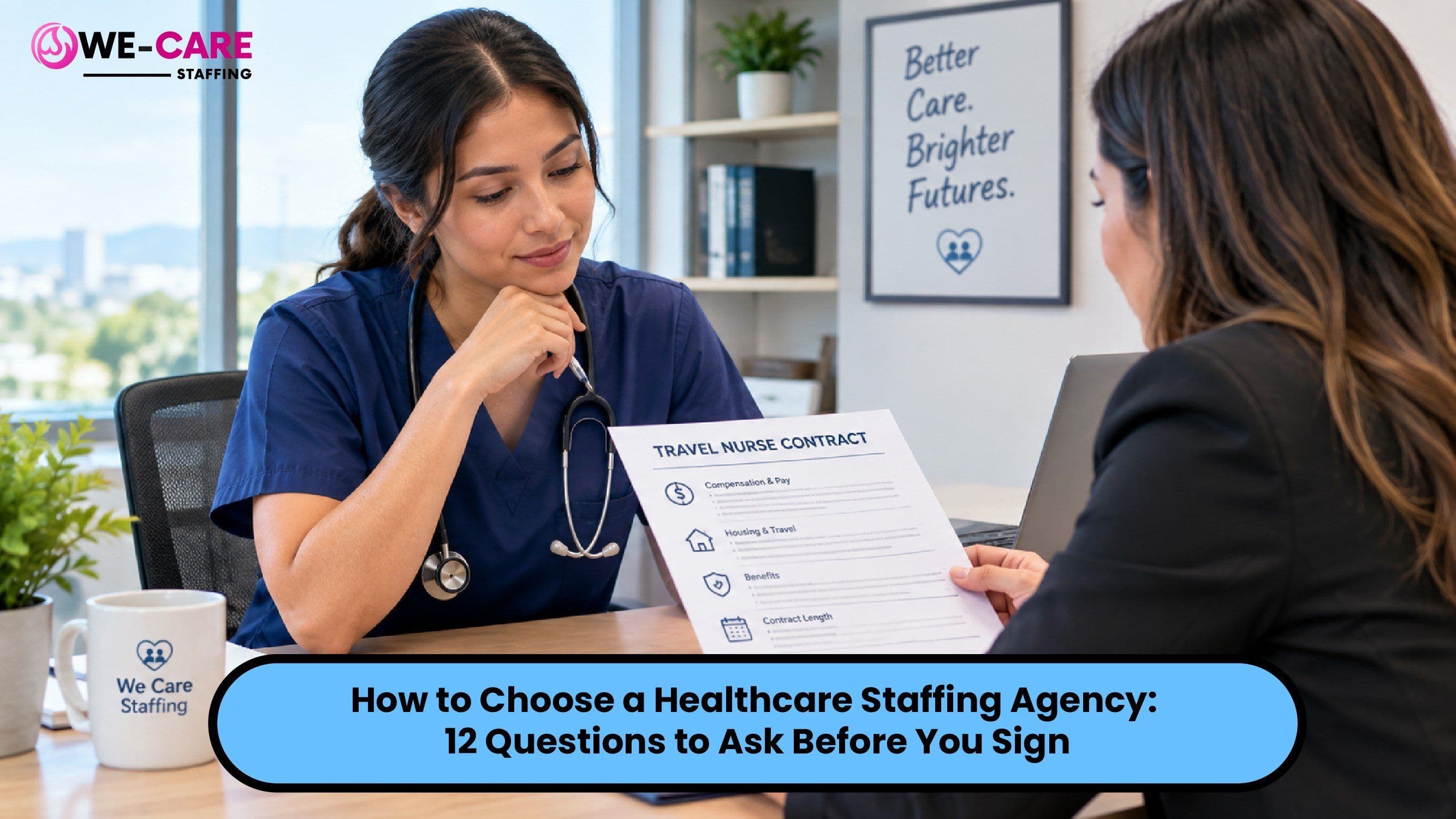
This guide gives you 12 questions to ask a healthcare staffing agency before you sign, covering pay transparency, guaranteed hours, credentialing, benefits, recruiter quality, and contract terms. Ask these of any agency you're considering, and pay attention not just to the answers but to how willingly they answer. A strong agency welcomes every one of these questions. If you'd like to see how we approach them, you can learn about our travel nursing program as you read.
Why the Agency You Choose Matters
Healthcare staffing agencies aren't interchangeable. They differ in how transparently they pay, how well they protect your income, how rigorously they credential, how good their benefits are, and how much they actually support you on assignment. The difference between a great agency and a poor one can be thousands of dollars and a great deal of stress over a single 13-week contract.
The good news: you can tell a lot before you ever sign, simply by asking the right questions and watching how the agency responds. Transparency is the theme running through all 12. An agency that answers openly is showing you how it will treat you as a client. Here's a quick truth to hold onto: a reputable agency earns its money from the facility, never from you, so if anyone asks you to pay a fee, that alone is a reason to walk away.
Questions About Pay and Compensation
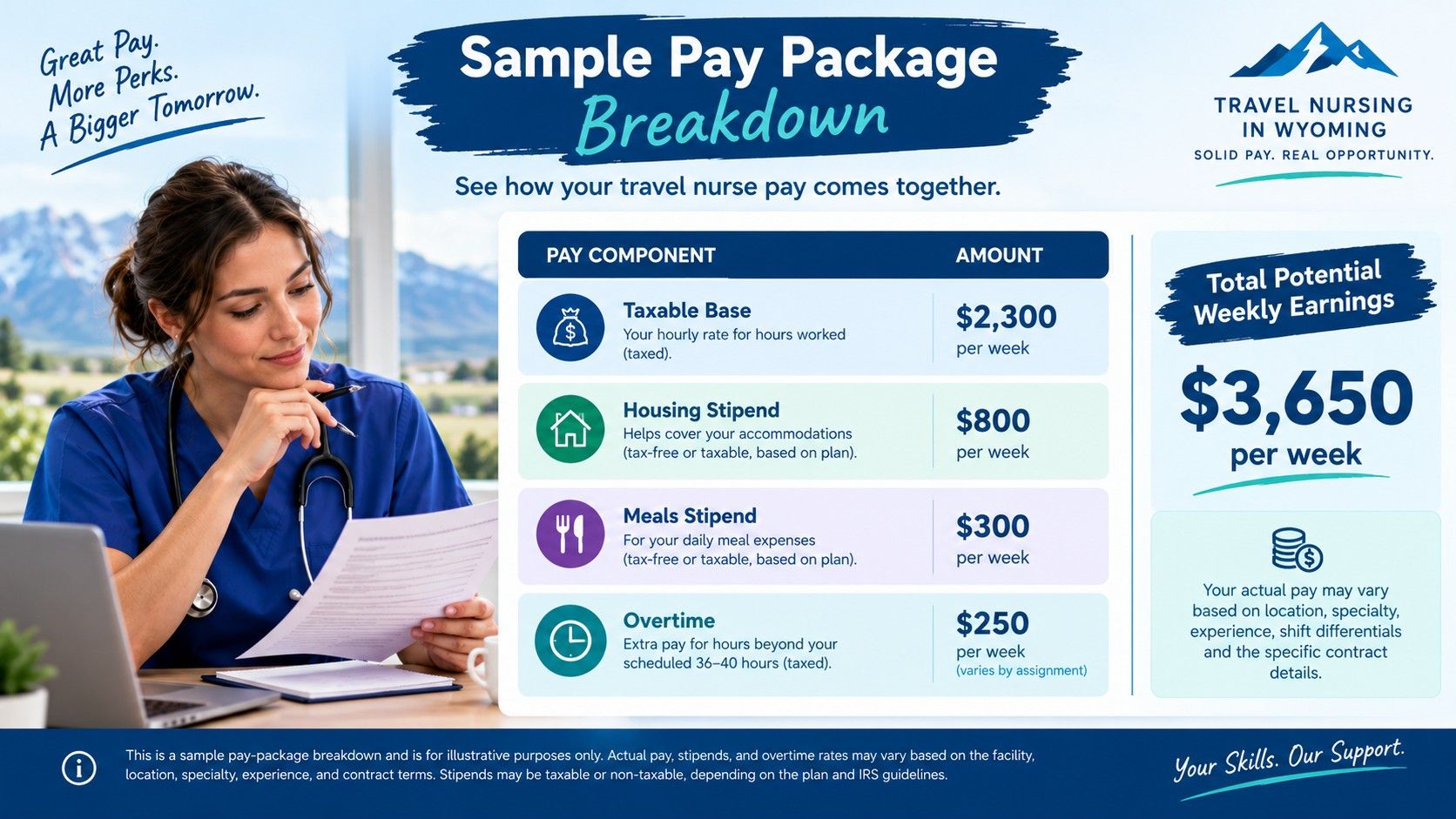
1. Can you show me the full pay breakdown in writing?
This is the first and most revealing question. A trustworthy agency will itemize every component: your taxable base hourly rate, tax-free housing stipend, meals and incidentals stipend, travel reimbursement, overtime rate, and any bonuses, and put it in writing. Be wary of any agency that quotes only a big weekly number without breaking it down. Opacity here is the single most common warning sign in the industry, because the details are where a package is either fair or quietly shortchanged.
2. What is the bill rate, and how is my package built from it?
The bill rate is what the hospital pays the agency for each hour you work. Your pay, your stipends, and the agency's margin all come out of it. Not every agency will disclose the full bill rate, and you aren't always entitled to it, but an agency willing to discuss its margin structure is signaling honesty. How they react to this question tells you a lot about how transparent they'll be about everything else.
3. How do overtime, holiday, and cancellation pay work?
Get specifics: your overtime rate (and how it's triggered, which varies by state), holiday pay, and, crucially, what happens if the facility cancels a shift. These details swing your real earnings more than the headline rate does.
Questions About Contract Protection
4. Are hours guaranteed, and what is the cancellation policy?
This may be the most financially important question of all. A guaranteed hours clause means you still get paid your contracted hours even if the facility puts you on low census (low patient volume) and cancels a shift. Without it, canceled shifts are simply unpaid, which can cost you hundreds or thousands over a slow week. Ask directly: "Does this contract guarantee my weekly hours, and what happens if the hospital cancels?" Get the answer in writing, in the contract, not as a verbal promise.
5. What are the exact contract terms, in writing?
Confirm the assignment length, exact shift type and schedule, floating and weekend requirements, extension process, and the notice period if you or the facility need to end early. Verbal assurances about schedule flexibility or "we'll work with you" mean nothing unless they're in the signed contract. Reputable agencies also give you adequate time, often 24 to 48 hours, to review a contract before signing. Anyone rushing you is a red flag.
Questions About Credentialing and Legitimacy
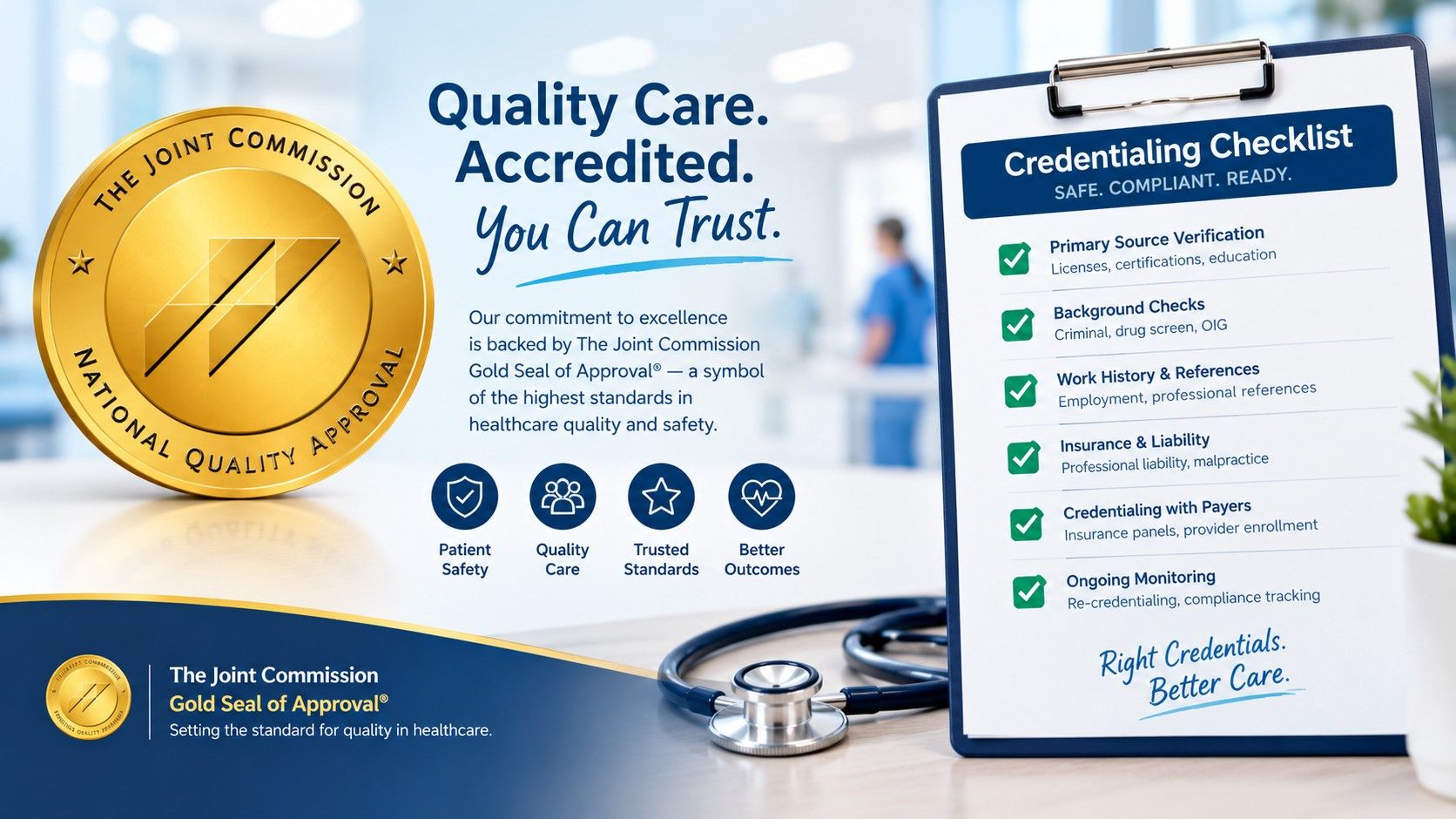
6. Are you Joint Commission certified or a NATHO member?
Credentialing rigor is a direct measure of how seriously an agency takes quality. Look for agencies that hold Joint Commission certification (the healthcare industry's Gold Seal for staffing firms) or belong to NATHO (the National Association of Travel Healthcare Organizations), which sets ethical standards for the industry. These aren't just badges; they signal an agency that meets recognized workforce and compliance standards, which protects both you and your patients.
7. Do you ever charge nurses any fees?
The answer should be an unambiguous no. Legitimate agencies are paid by the facility, never by the clinician. If an agency asks you to pay for placement, credentialing, or "processing," treat it as a serious red flag and walk away.
Questions About Benefits and Support
8. What benefits are included, and does health insurance start on day one?
Ask what's actually covered: health, dental, and vision insurance (and whether it starts day one or after a gap), 401(k), license and certification reimbursement, continuing education, and any completion bonuses. A gap in health coverage between assignments is a common hidden cost, so day-one insurance is a meaningful advantage worth asking about directly.
9. How does housing work: agency-provided or stipend?
Understand your options clearly. Most travelers take the tax-free housing stipend and arrange their own place, while some prefer agency-provided housing where the agency handles it. Ask which the agency offers, how much support they provide in finding housing, and, if you take the stipend, confirm it's realistic for the assignment's location. (Remember stipends are only tax-free if you maintain a legitimate tax home and the assignment is temporary under IRS rules.)
10. What support will I have during my assignment?
An assignment can go sideways: a difficult unit, a documentation problem, a housing issue, a payroll error. Ask what happens when it does. Is there 24/7 clinical or operational support? Who do you call? A good agency stands behind you throughout the contract, not just until you sign.
Questions About the Recruiter and the Agency

11. Will I have a dedicated recruiter, and do they listen to my goals?
Your recruiter is your day-to-day lifeline, so this relationship matters enormously. Notice whether the recruiter asks about your goals, specialty, and preferred locations, or just pushes whatever contracts they need to fill. A dedicated, responsive recruiter who treats you as a professional partner is one of the biggest differences between a good agency experience and a frustrating one. Test it early: how quickly and personally did they respond to your first contact?
12. What is your reputation, history, and specialty coverage?
Finally, vet the agency itself. How long have they been in business? What's their size and geographic focus? Do they actually staff your specialty and preferred locations? What do current reviews and fellow travelers say? Ask for references or read independent reviews. An established agency with verifiable history, a real physical address, and genuine coverage in your specialty is a safer partner than an unknown promising the highest rate. You can usually learn a lot from an agency's own About page and by talking directly with its team.
Red Flags to Watch For
If you notice several of these, be cautious:
- Won't provide a written, itemized pay breakdown.
- Dodges the guaranteed-hours or cancellation question.
- Rushes you to sign without time to review the contract.
- Asks you to pay any fee.
- Makes verbal promises that never make it into the contract.
- No verifiable credentials, address, or history.
- A recruiter who pushes contracts without asking about your goals.
How to Compare Agencies
Many experienced travelers work with two or three agencies at once, often one larger agency for volume and one boutique agency for personalized service and specialty pay, which gives you more options and negotiating leverage. To compare fairly:
- Define your priorities first: highest pay, best benefits, specific locations, recruiter relationship, or specialty focus.
- Ask all 12 questions of each agency and compare the answers side by side.
- Weigh transparency as heavily as pay. The most open agency often delivers the best real experience.
- Compare net, not just gross. Factor stipends, benefits, insurance gaps, and guaranteed hours into the true value.
Conclusion
Choosing a healthcare staffing agency is one of the most important decisions in a travel or contract career, and it deserves more than a glance at the weekly rate. Ask about the full pay breakdown, guaranteed hours, credentialing, benefits, housing, support, and recruiter quality, and watch how openly each agency responds. Transparency is the throughline: an agency that answers all 12 questions honestly is showing you exactly how it will treat you. Ask well, compare fairly, and you'll partner with an agency that puts your career first. If you'd like to see how we answer these questions, reach out to our team or explore our travel nursing program to get started.
References & Sources
All guidance reflects current travel-healthcare industry standards as described by the following sources (accessed June 2026). Agency policies vary; always confirm specifics with each agency and in your own contract.
- The Joint Commission — Health Care Staffing Services Certification (credentialing standards / Gold Seal): https://www.jointcommission.org/what-we-offer/certification/certifications-by-setting/health-care-staffing-services/
- NATHO (National Association of Travel Healthcare Organizations) — ethical standards: https://natho.org
- Industry recruiter-question and agency-selection guides (pay transparency, bill rate, guaranteed hours): https://excursionhealth.com/blog/travel-nurse-recruiter-questions/ and https://concentrichealthcare.com/how-to-choose-a-travel-nurse-staffing-agency-what-actually-matters/
- IRS Publication 463 — Tax Home and Travel Expense Rules (stipend tax-free eligibility): https://www.irs.gov/publications/p463
- U.S. Bureau of Labor Statistics — Registered Nurses (baseline pay context): https://www.bls.gov/ooh/healthcare/registered-nurses.htm
Questions
Frequently asked
Looking for your next assignment?
Browse current travel contracts, or tell a recruiter what you are after and we will match you against roles before they are listed.