12-Hour Shifts, Night Shifts & 48-Hour Contracts for California RNs
If you're an RN working in California, your schedule isn't just a lifestyle choice, it's a pay calculation governed by some of the strongest labor laws in the country. California's overtime rules work differently from most states, and understanding them is the difference between accepting a 48-hour contract that pays beautifully and one that quietly shortchanges you. The good news: when the rules are followed, California rewards long-shift and night-shift nurses generously.

We Care Staffing

This guide explains how 12-hour shifts, night shifts, and 48-hour contracts actually work for California RNs, including the state's unique daily-overtime and double-time rules, meal and rest break protections, and how to make the schedule work for your paycheck and your health. If you're weighing California assignments, you can explore current California RN openings with We Care Staffing as you read.
A note before we start: this article explains California labor rules in general, plain-language terms. It is not legal advice, and your specific situation depends on your employer, contract, and current law. For a wage dispute, consult a California labor attorney or the Labor Commissioner's Office.
Why California Is Different: Daily Overtime
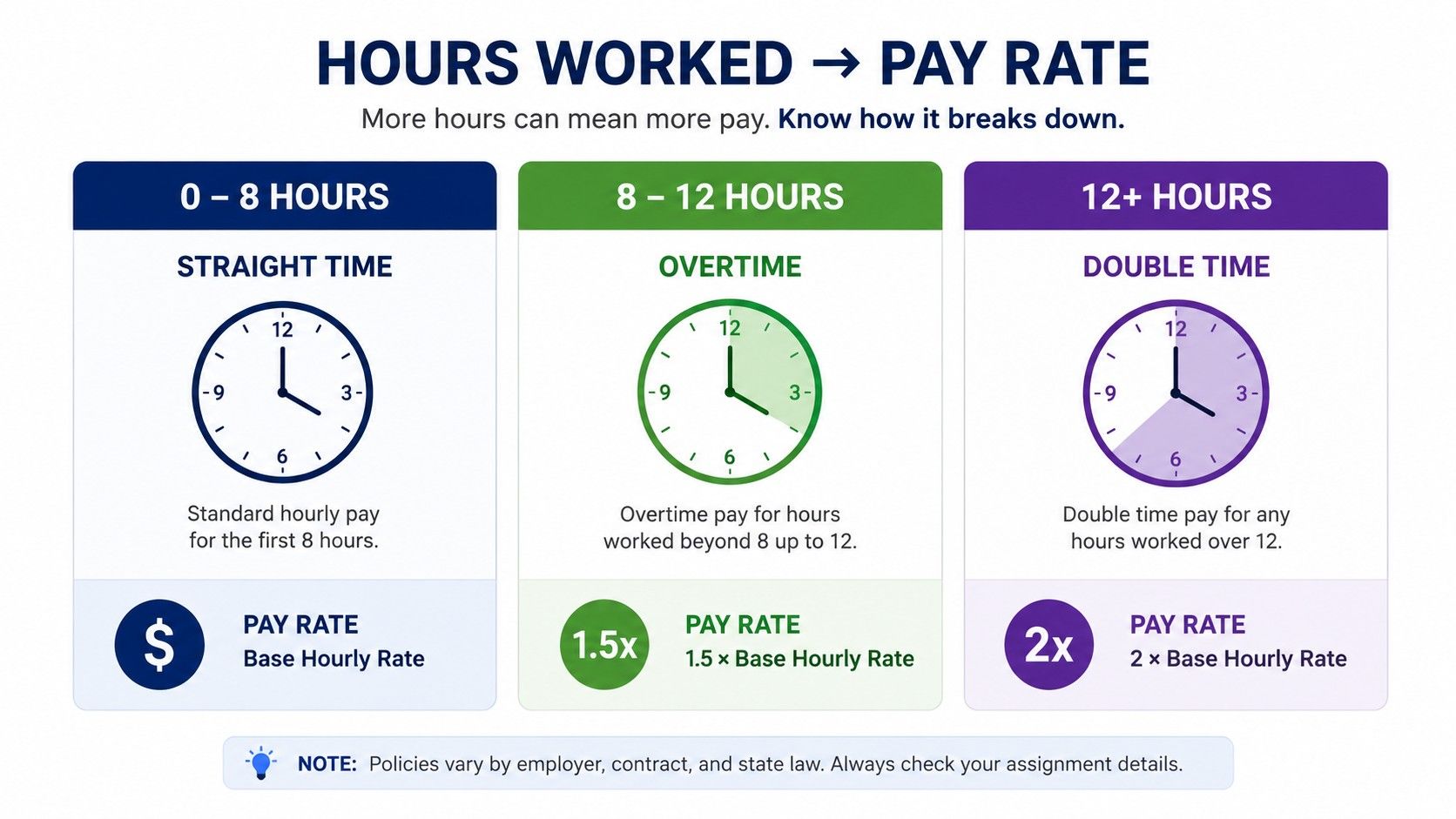
Most states only pay overtime after 40 hours in a week. California is one of the few states with daily overtime. For a standard non-exempt nurse, that means:
- Time-and-a-half (1.5x) for hours worked beyond 8 in a single day, and for the first 8 hours on a seventh consecutive workday.
- Double time (2x) for hours worked beyond 12 in a single day, and beyond 8 on that seventh consecutive day.
- Time-and-a-half also still applies beyond 40 hours in a week.
This daily structure is exactly why California nursing schedules, and travel contracts, are built the way they are. It also means the classic 12-hour shift needs special handling, which brings us to the alternative workweek.
12-Hour Shifts and the Alternative Workweek Schedule (AWS)
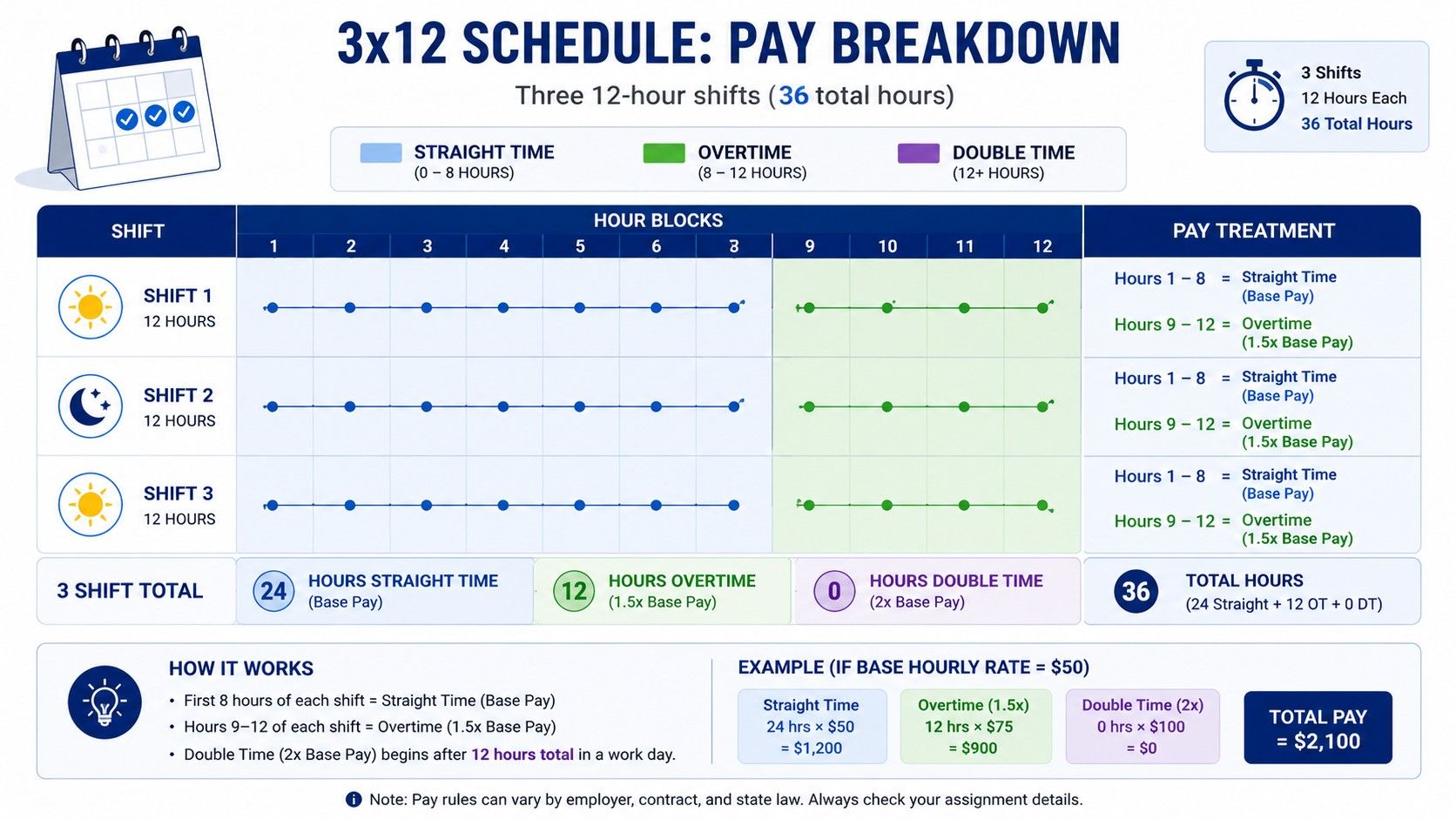
Here's the piece that trips up nurses and employers alike. Under California's default daily-overtime rule, hours 9 through 12 of any shift would normally be overtime. So how do hospitals run 12-hour shifts without paying overtime on every one?
The answer is the Alternative Workweek Schedule (AWS), permitted for healthcare under California's Industrial Welfare Commission Wage Order 5. When a valid AWS is in place:
- A nurse can work up to 12 hours in a shift at their regular rate, meaning hours 9 through 12 are not automatically daily overtime.
- Double time still applies after 12 hours in a day, no exceptions. If you stay late and work a 13th hour, that hour is paid at 2x.
- The 40-hour weekly overtime rule still stands, so hours beyond 40 in the week are paid at time-and-a-half.
The critical catch: an AWS is only valid if the employer followed strict adoption rules, which for standard AWS arrangements include a secret-ballot election of affected employees, a regular fixed schedule, and registration with the state. (In healthcare, there are also provisions allowing individual employees to elect 12-hour schedules under Wage Order 5.) If the employer didn't properly adopt the AWS, those hours 9 through 12 revert to overtime, and nurses may be owed back pay. Several large wage-and-hour settlements involving nurses have turned on exactly this issue.
The practical takeaway: a properly run 12-hour hospital schedule is completely legal and common, but the paperwork behind it determines how your hours 9 through 12 get paid.
How a 48-Hour Contract Week Actually Pays
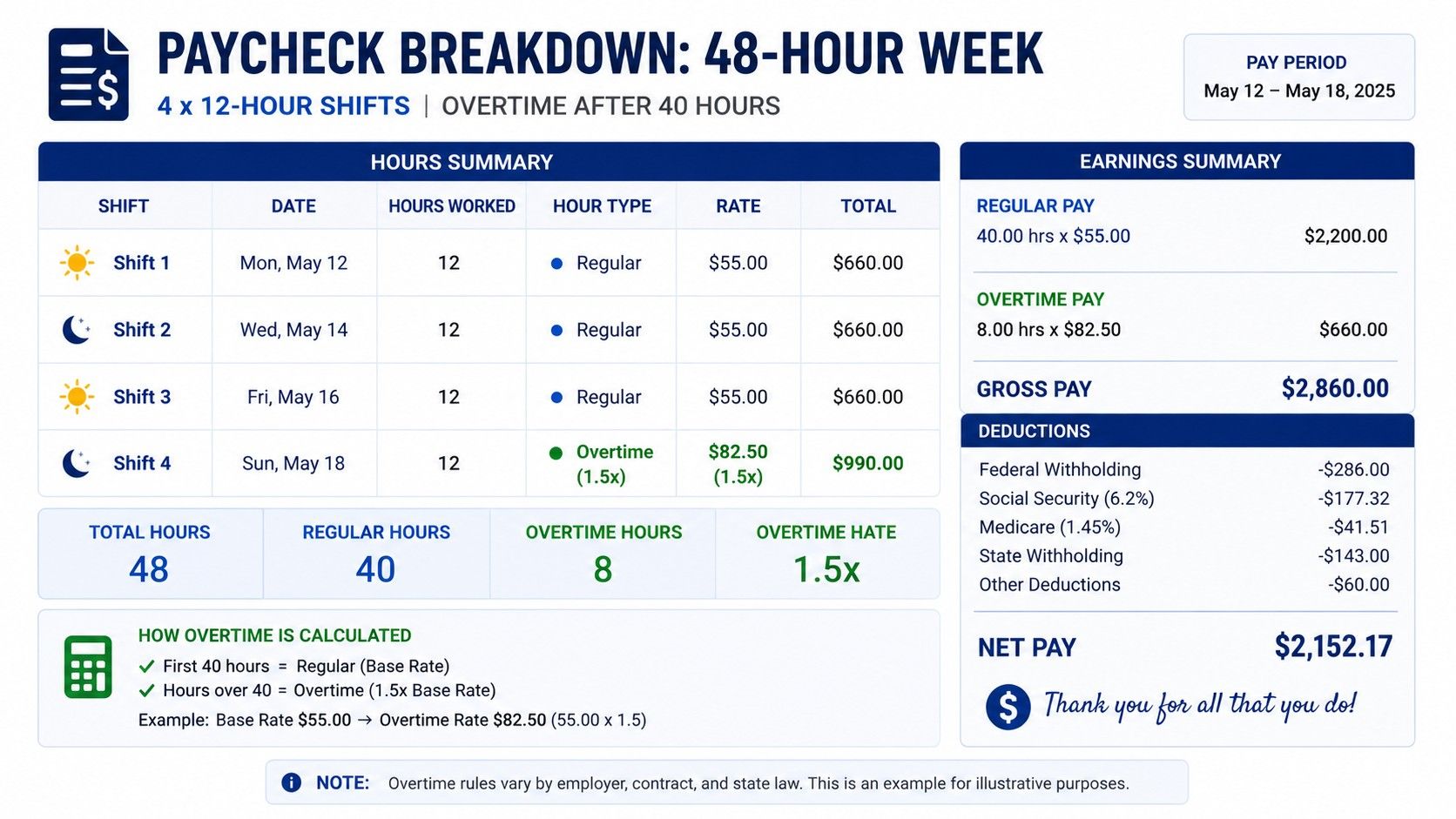
Travel and per diem contracts advertising "48 hours a week" are common in California, and they can pay extremely well, but only if you understand the math. A 48-hour week is typically four 12-hour shifts. Here's the general shape of how it's paid for a non-exempt nurse under a valid AWS:
- The first 40 hours are paid at your regular contract rate (with hours 9 through 12 each day at straight time under the AWS).
- The remaining 8 hours (the hours beyond 40 in the week) are paid at time-and-a-half.
- Any hours beyond 12 in a single day are double time, on top of the above.
That built-in overtime on the back 8 hours is a big part of why 48-hour California contracts are lucrative. It's also why you should always confirm two things before signing: whether a valid AWS is in place, and exactly how the contract defines regular versus overtime hours. A 48-hour contract that doesn't correctly pay the weekly overtime, or that misapplies the AWS, is a red flag.
Note as well that mandatory overtime is limited for California nurses. Employers generally cannot force overtime beyond your scheduled shift except in defined emergencies, and only after making reasonable efforts to find voluntary staffing first. Voluntarily picking up extra shifts is different from being mandated to stay.
Night Shifts: Differentials and the Health Trade-Off

Night shifts are where California RNs can meaningfully boost earnings, and where you have to protect your health.
The pay upside. California does not mandate a specific night-shift differential by law, so differentials are set by employer or union contract, but they are common and often substantial at major systems, typically adding a few dollars to $10-plus per hour for nights, with additional premiums for weekends and holidays. Over a year, night differentials on a full-time schedule can add thousands to tens of thousands of dollars. Importantly, differentials generally factor into your "regular rate," which can raise the value of your overtime hours too.
The health reality. Night-shift work disrupts circadian rhythm and is linked to real risks over time, including sleep disruption, fatigue, and long-term health effects. This isn't a reason to avoid nights, many nurses prefer them, but a reason to work them deliberately: protect your sleep with a dark, quiet daytime environment, keep a consistent schedule even on days off where possible, manage caffeine timing, prioritize nutrition, and watch for signs of chronic fatigue. Your paycheck benefits from nights; your body needs you to plan around them.
Meal and Rest Breaks: Your Rights on a Long Shift
California break protections are strong, and they matter most on 12-hour shifts:
- Meal breaks: A 30-minute unpaid meal break is required once you work more than 5 hours (it must begin before the end of the fifth hour), and a second 30-minute meal break is required for shifts over 10 hours.
- The 12-hour waiver: On long shifts, a nurse may voluntarily waive one of the two meal breaks in writing, and that waiver can typically be revoked with a day's notice. This is extremely common on 12-hour shifts, letting nurses leave earlier, but it must be voluntary and documented. You generally cannot waive the second meal break if your shift exceeds 12 hours.
- Rest breaks: A paid 10-minute rest break for roughly every 4 hours worked.
- Missed breaks = premium pay: If your employer fails to provide a compliant meal or rest break, you're generally owed one additional hour of pay at your regular rate for each type of violation. Auto-deducting break time you actually worked has driven multimillion-dollar nurse settlements in California.
Know these rights, and track your breaks, especially as a traveler, since break-related wage claims are among the most common in California nursing.
How to Make Long and Night Shifts Work for You
- Confirm the AWS before signing. Ask whether a valid alternative workweek schedule is in place and how hours 9 through 12 are paid.
- Do the 48-hour math. Verify the contract pays weekly overtime on hours beyond 40 and double time beyond 12 in a day.
- Value the differentials. Factor night, weekend, and holiday premiums into your real hourly rate, not just the base.
- Protect your break rights. Track meal and rest breaks; missed-break premiums are real money.
- Guard your sleep and health on nights. Treat recovery as part of the job.
- Keep records. Save your schedules and pay stubs; they're your evidence if a pay dispute arises.
Conclusion
California's labor laws make long shifts, night shifts, and 48-hour contracts some of the most financially rewarding in the country for RNs, precisely because the state pays daily overtime, double time past 12 hours, and protects your breaks. The key is understanding the machinery: a valid alternative workweek schedule is what makes straight-time 12-hour shifts legal, the back 8 hours of a 48-hour week should carry overtime, night differentials meaningfully lift your earnings, and your break rights carry real dollar penalties when violated. Know the rules, confirm them in every contract, and protect your health on nights, and California's demanding schedules can pay off in every sense. When you're ready, browse current California RN jobs and let a recruiter walk you through the pay structure of any contract.
References & Sources
All rules are described in general terms from the following sources (accessed June 2026). California's Department of Industrial Relations (DIR) and Wage Order 5 are the authoritative baselines; this is not legal advice.
- California Department of Industrial Relations (DIR) — Overtime and Wage Order 5 (public housekeeping / healthcare): https://www.dir.ca.gov/dlse/faq_overtime.htm
- California DIR — Meal and Rest Break rules: https://www.dir.ca.gov/dlse/faq_mealperiods.htm
- California Wage Order 5 (IWC) — alternative workweek schedules and healthcare provisions: https://www.dir.ca.gov/iwc/wageorderindustries.htm
- Cal Comply — 12-hour shifts and break waivers for California healthcare (AWS mechanics, hours 9–12, double time after 12): https://calcomply.com/12-hour-shifts-break-waivers-wage-hour-rules-for-california-healthcare/
- Shouse Law / Ferraro Vega / Coast Employment Law — California nurse overtime and AWS explainers (daily OT, double time, mandatory OT limits): https://www.shouselaw.com/ca/blog/are-there-special-overtime-rules-for-hospital-workers-in-california/
- U.S. Bureau of Labor Statistics — Registered Nurses (baseline pay context): https://www.bls.gov/ooh/healthcare/registered-nurses.htm
Questions
Frequently asked
Looking for your next assignment?
Browse current travel contracts, or tell a recruiter what you are after and we will match you against roles before they are listed.